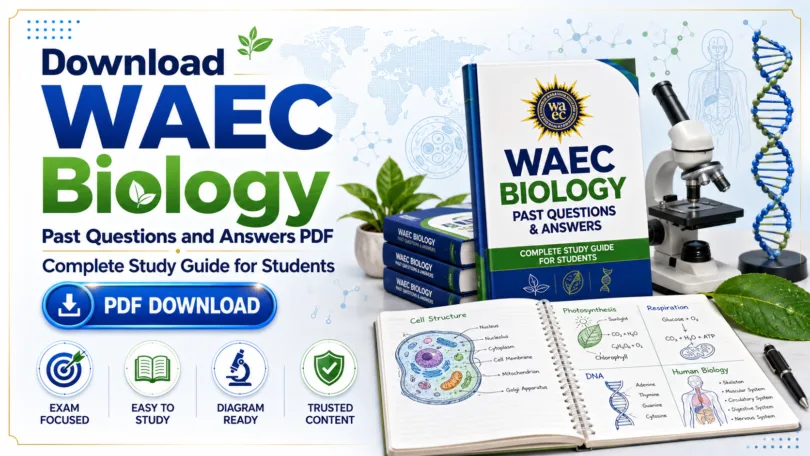

Download WAEC Biology Past Questions and Answers PDF: Are you preparing for WAEC Biology and looking for past questions and answers to help you study better? This guide explains how to use WAEC Biology past questions correctly, important topics to focus on, sample practice questions, practical tips, and useful revision methods for candidates.
Biology is one of the major science subjects in WAEC. It helps students understand living things, cells, plants, animals, human body systems, reproduction, genetics, ecology, evolution, diseases, and the relationship between organisms and their environment.
WAEC Biology past questions are useful because they help candidates understand the exam pattern, common topics, practical areas, and the best way to answer objective, theory, and practical questions.
What Are WAEC Biology Past Questions?
WAEC Biology past questions are previous examination questions used to test students’ knowledge of living organisms, biological processes, classification, ecology, genetics, physiology, and practical biology.
These past questions may include:
- Objective questions
- Theory questions
- Practical questions
- Diagram-based questions
- Specimen identification
- Questions on plants and animals
- Human biology questions
- Ecology and genetics questions
Past questions help students to:
- Understand the WAEC Biology exam format
- Know important topics that appear often
- Practise objective and theory questions
- Prepare for practical questions
- Improve diagram drawing and labeling
- Identify weak areas before the exam
- Build confidence before exam day
Past questions should be used for revision and practice only, not for cheating or examination malpractice.
Why Students Should Download WAEC Biology Past Questions and Answers PDF
Downloading or accessing WAEC Biology past questions can help students prepare in a more organized way. Biology is a subject that requires both understanding and memory, especially in areas like classification, human body systems, reproduction, ecology, and practical specimens.
When candidates practise Biology past questions regularly, they become familiar with:
- WAEC question styles
- Common Biology topics
- Practical specimen questions
- Diagram labeling
- Repeated topic areas
- How to answer theory questions clearly
- Time management during the exam
However, students should not depend on past questions alone. They should also study their Biology textbook, class notes, practical notes, diagrams, and the official syllabus.
Also Read: Download WAEC Economics Past Questions and Answers PDF 2026
Important Topics in WAEC Biology
Below are major topics candidates should study while preparing for WAEC Biology.
1. Living Things and Non-Living Things
Students should understand the basic characteristics of living organisms.
Important areas include:
- Meaning of Biology
- Characteristics of living things
- Differences between plants and animals
- Differences between living and non-living things
- Levels of organization of life
- Cell, tissue, organ, system, and organism
- Importance of Biology
The characteristics of living things include movement, respiration, nutrition, irritability, growth, excretion, reproduction, and adaptation.
2. Classification of Living Organisms
Classification helps scientists group organisms according to their similarities and differences.
Students should study:
- Meaning of classification
- Importance of classification
- Kingdoms of living organisms
- Binomial nomenclature
- Taxonomic groups
- Monera
- Protista
- Fungi
- Plantae
- Animalia
- Characteristics of major groups
Candidates should understand how organisms are grouped and the features that distinguish each group.
3. The Cell
The cell is the basic unit of life. It is one of the most important topics in Biology.
Important areas include:
- Meaning of cell
- Cell theory
- Plant cell
- Animal cell
- Cell membrane
- Cytoplasm
- Nucleus
- Mitochondrion
- Chloroplast
- Cell wall
- Vacuole
- Differences between plant and animal cells
- Functions of cell organelles
4. Nutrition in Plants
Plants make their own food through photosynthesis.
Students should study:
- Autotrophic nutrition
- Photosynthesis
- Conditions necessary for photosynthesis
- Products of photosynthesis
- Importance of photosynthesis
- Mineral requirements of plants
- Nitrogen cycle
- Deficiency symptoms in plants
5. Nutrition in Animals
Animals cannot manufacture their own food, so they depend on plants or other animals.
Important areas include:
- Heterotrophic nutrition
- Classes of food
- Balanced diet
- Food tests
- Digestive system
- Digestion in humans
- Absorption and assimilation
- Enzymes
- Feeding habits in animals
Students should understand the functions of carbohydrates, proteins, fats, vitamins, minerals, water, and roughage.
6. Transport System
Transport systems help move materials around the body of organisms.
Students should study:
- Diffusion
- Osmosis
- Active transport
- Transport in plants
- Xylem
- Phloem
- Transpiration
- Translocation
- Transport in animals
- Blood
- Blood vessels
- Heart
- Circulatory system
7. Respiration
Respiration is the process by which organisms release energy from food.
Important areas include:
- Meaning of respiration
- Aerobic respiration
- Anaerobic respiration
- Differences between breathing and respiration
- Respiratory system in humans
- Gas exchange
- Breathing mechanism
- Respiration in plants
- Importance of respiration
8. Excretion
Excretion is the removal of metabolic waste products from the body.
Students should study:
- Meaning of excretion
- Excretory products
- Excretion in plants
- Excretion in animals
- Kidney
- Skin
- Lungs
- Liver
- Urinary system
- Importance of excretion
9. Reproduction
Reproduction is the process by which organisms produce offspring.
Important areas include:
- Asexual reproduction
- Sexual reproduction
- Reproduction in plants
- Pollination
- Fertilization
- Seed formation
- Fruit formation
- Dispersal of fruits and seeds
- Reproduction in humans
- Male reproductive system
- Female reproductive system
- Menstrual cycle
- Fertilization and pregnancy
10. Growth and Development
Students should understand how organisms increase in size and develop.
Important areas include:
- Meaning of growth
- Growth in plants
- Growth in animals
- Germination
- Conditions necessary for germination
- Metamorphosis
- Measurement of growth
- Growth curves
11. Coordination and Control
Coordination helps organisms respond to changes in their environment.
Students should study:
- Nervous system
- Brain
- Spinal cord
- Neurons
- Reflex action
- Sense organs
- Eye
- Ear
- Hormones
- Endocrine glands
- Coordination in plants
- Tropism
- Nastic movement
12. Ecology
Ecology is the study of organisms and their environment.
Important areas include:
- Meaning of ecology
- Ecosystem
- Habitat
- Niche
- Population
- Community
- Food chain
- Food web
- Pyramid of numbers
- Energy flow
- Decomposition
- Symbiosis
- Parasitism
- Competition
- Predator-prey relationship
13. Adaptation
Adaptation helps organisms survive in their environment.
Students should study:
- Meaning of adaptation
- Structural adaptation
- Behavioural adaptation
- Physiological adaptation
- Adaptation of plants
- Adaptation of animals
- Aquatic habitat
- Terrestrial habitat
- Desert habitat
- Forest habitat
- Grassland habitat
14. Genetics and Heredity
Genetics is another important area in WAEC Biology.
Important areas include:
- Meaning of heredity
- Genes
- Chromosomes
- DNA
- Dominant traits
- Recessive traits
- Genotype
- Phenotype
- Mendel’s experiments
- Monohybrid crossing
- Sex determination
- Variation
- Mutation
- Blood groups
15. Evolution
Evolution explains how living organisms change over time.
Students should study:
- Meaning of evolution
- Evidence of evolution
- Fossils
- Comparative anatomy
- Natural selection
- Variation
- Adaptation and survival
- Charles Darwin
16. Health and Diseases
Biology also teaches students about health, disease prevention, and hygiene.
Important areas include:
- Meaning of disease
- Communicable diseases
- Non-communicable diseases
- Pathogens
- Vectors
- Malaria
- Cholera
- Tuberculosis
- HIV/AIDS
- Immunity
- Vaccination
- Personal hygiene
- Public health
- Disease prevention
How to Use WAEC Biology Past Questions Effectively
Past questions are useful, but students must use them correctly.
1. Start With the Syllabus: Before answering past questions, go through the WAEC Biology syllabus. The syllabus helps you know the areas you are expected to study.
2. Study Topic by Topic: Do not read randomly. Study one topic first, then answer past questions under that topic.
For example, after studying reproduction in plants, answer questions on pollination, fertilization, seed formation, and seed dispersal.
3. Draw and Label Diagrams: Biology often requires diagrams. Practise drawing simple and neat diagrams such as:
- Plant cell
- Animal cell
- Human heart
- Kidney
- Digestive system
- Respiratory system
- Flower
- Seed
- Leaf
- Eye
- Ear
Label your diagrams clearly and avoid rough drawings.
4. Practise Objective Questions: Objective questions help you test your memory and understanding. Try to answer them without checking the answers first.
5. Practise Theory Questions: For theory questions, write clear points and explain them briefly. Use biological terms correctly.
6. Prepare for Practical Biology: Do not ignore practical work. Learn how to identify specimens, draw diagrams, state features, and explain functions.
7. Review Your Mistakes: After answering past questions, check your mistakes and revise the topics you did not understand well.
Sample WAEC Biology Practice Questions
Below are simple practice-style questions for revision. These are not live WAEC questions. They are only for study purposes.
Objective Practice Questions
- The basic unit of life is the:
A. Tissue
B. Organ
C. Cell
D. System
Answer: C. Cell
- The green pigment in plants that traps sunlight is called:
A. Haemoglobin
B. Chlorophyll
C. Melanin
D. Enzyme
Answer: B. Chlorophyll
- The organ responsible for pumping blood in humans is the:
A. Kidney
B. Lung
C. Heart
D. Liver
Answer: C. Heart
- The process by which green plants manufacture food is called:
A. Respiration
B. Photosynthesis
C. Transpiration
D. Digestion
Answer: B. Photosynthesis
- The male reproductive cell is called:
A. Ovum
B. Sperm
C. Zygote
D. Embryo
Answer: B. Sperm
Theory Practice Questions
- Define Biology and state four importance of Biology.
- State five differences between plant and animal cells.
- Explain the process of photosynthesis.
- Describe the functions of the human heart.
- State four differences between aerobic and anaerobic respiration.
- Explain three methods of seed dispersal.
- State five functions of blood.
- Explain the importance of food chains in an ecosystem.
Practical Biology Areas to Study
WAEC Biology practical usually tests students’ ability to identify specimens, draw diagrams, state features, and explain biological functions.
Common practical areas include:
- Plant specimens
- Animal specimens
- Fruits and seeds
- Leaves
- Flowers
- Insects
- Bones
- Food tests
- Microscopy
- Cells and tissues
- Ecological specimens
- Adaptation features
Common Biology Specimens
Students should be familiar with specimens such as:
- Hibiscus flower
- Maize grain
- Bean seed
- Grasshopper
- Cockroach
- Earthworm
- Fish
- Tadpole
- Leaf
- Root
- Stem
- Bird feather
- Mammalian tooth
- Bones
- Fruits
- Snail shell
Tips for WAEC Biology Practical
- Observe specimens carefully.
- Write the correct name of each specimen.
- State visible features.
- Draw clear diagrams.
- Label diagrams properly.
- State functions of parts where required.
- Use a sharp pencil for diagrams.
- Avoid shading diagrams heavily.
- Do not draw from memory when a specimen is provided.
- Manage your time properly.
How to Answer WAEC Biology Theory Questions
To answer Biology theory questions correctly, follow these tips:
- Read the question carefully.
- Define key terms where necessary.
- Use correct biological terms.
- Write clear points.
- Explain each point briefly.
- Draw diagrams where necessary.
- Label diagrams correctly.
- Avoid writing off-topic information.
For example, if a question asks for the functions of blood, mention points such as transport of oxygen, transport of nutrients, removal of waste products, defence against diseases, regulation of body temperature, and clotting to prevent blood loss.
Common Mistakes Students Make in WAEC Biology
Many candidates lose marks because of simple mistakes. Avoid the following:
- Ignoring diagrams
- Poor labeling of diagrams
- Memorizing without understanding
- Confusing biological terms
- Not reading practical instructions carefully
- Writing off-topic answers
- Not learning specimens
- Depending only on past questions
- Depending on fake exam answers
- Not reading the syllabus
Biology becomes easier when students understand processes and practise diagrams regularly.
WAEC Biology Study Plan for Students
Here is a simple study plan for candidates.
Week 1: Basic Biology and Cells
Study characteristics of living things, classification, cells, tissues, organs, plant cells, animal cells, and cell functions.
Week 2: Nutrition, Transport and Respiration
Revise photosynthesis, food tests, digestive system, transport in plants, blood, heart, respiration, and gas exchange.
Week 3: Excretion, Reproduction and Growth
Study excretion in plants and animals, kidney, reproduction in plants, reproduction in humans, germination, and growth.
Week 4: Coordination, Ecology and Adaptation
Revise nervous system, sense organs, hormones, tropism, ecosystems, food chains, food webs, habitats, and adaptation.
Week 5: Genetics, Evolution and Health
Study genes, chromosomes, inheritance, variation, mutation, evolution, diseases, immunity, and hygiene.
Week 6: Practical and Past Question Practice
Practise specimen identification, diagrams, objective questions, theory questions, and revision of weak topics.
Benefits of Practising WAEC Biology Past Questions
Practising Biology past questions helps students to:
- Understand the exam format
- Know common topics
- Improve diagram drawing
- Prepare for practical questions
- Learn biological terms
- Build confidence
- Manage exam time
- Identify weak areas before the exam
Past questions are helpful, but candidates should also study textbooks, class notes, practical notes, diagrams, and the syllabus.
Can WAEC Repeat Biology Questions?
WAEC may test similar topics from previous years, but candidates should not depend on exact repeated questions. Questions may appear in a different form even when the topic is the same.
For example, photosynthesis can be asked as a definition, equation, conditions, importance, experiment, or comparison with respiration. If you understand the topic, you can answer any version of the question.
Safe Way to Get WAEC Biology Past Questions
Students can get WAEC Biology past questions from:
- School teachers
- Approved bookshops
- School libraries
- Trusted educational platforms
- Legal study materials
- Past question booklets
Avoid websites or people that promote “WAEC expo,” “runs,” “live answers,” or “confirmed questions.” These may mislead students and encourage examination malpractice.
Warning Against Fake WAEC Biology Answers
Students should be careful of people who claim to sell:
- WAEC Biology expo
- Live Biology answers
- Confirmed questions before the exam
- Miracle centre answers
- Guaranteed WAEC success
These claims are unsafe and unreliable. The best way to pass Biology is to study early, understand biological processes, practise diagrams, prepare for practicals, and answer past questions honestly.
This article is for study and revision only. It does not provide live exam answers or examination malpractice materials.
Frequently Asked Questions
Where can I download WAEC Biology past questions and answers?
You can access WAEC Biology past questions from teachers, approved bookshops, school libraries, trusted educational websites, and legal study platforms.
Are WAEC Biology past questions useful?
Yes. They help students understand the exam format, revise important topics, practise diagrams, and prepare better.
Can I pass Biology by reading only past questions?
Past questions are helpful, but they are not enough. You should also study your textbook, class notes, practical notes, diagrams, and the syllabus.
Does WAEC repeat Biology questions?
WAEC may test similar topics, but students should not depend on exact repeated questions. Understanding the topics is better.
Why do students fail WAEC Biology?
Some students fail because they memorize without understanding, ignore diagrams, do not prepare for practicals, confuse biological terms, or depend on fake exam answers.
How can I pass WAEC Biology?
Study the syllabus, revise your notes, practise diagrams, learn specimens, answer past questions, and prepare well for practical Biology.
Is Biology important for science students?
Yes. Biology is important for students who want to study Medicine, Nursing, Pharmacy, Microbiology, Biochemistry, Agriculture, Medical Laboratory Science, and other life science courses.
Conclusion
WAEC Biology past questions and answers are very useful for students preparing for the examination. They help candidates understand the exam pattern, revise important topics, improve diagram skills, and prepare for practical questions.
To perform well in Biology, students should study the syllabus, understand biological processes, practise objective and theory questions, draw neat diagrams, learn practical specimens, and avoid fake exam answers.
Success in WAEC Biology comes from early preparation, regular revision, practical knowledge, and honest study.
Disclaimer: This article is for educational and revision purposes only. We are not WAEC, and we do not provide live exam answers, expo, or examination malpractice materials. Students should use only legal and trusted study resources when preparing for their examination.