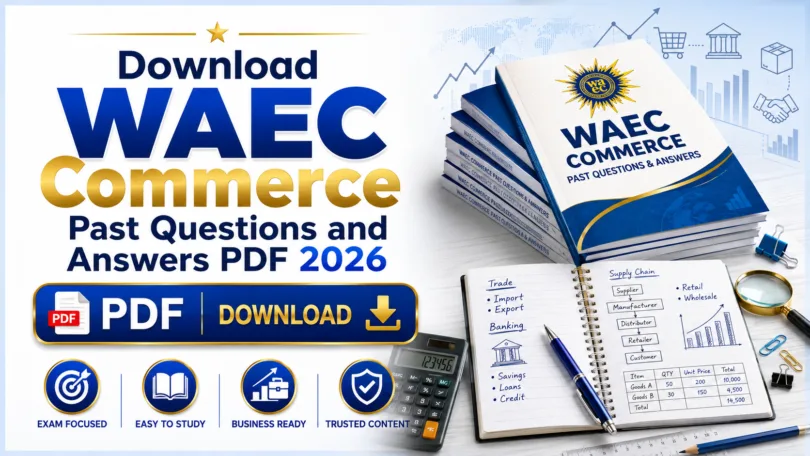

Download WAEC Commerce Past Questions and Answers PDF 2026: Are you preparing for WAEC Commerce and looking for past questions and answers to help you study better? This guide explains how to use WAEC Commerce past questions correctly, important topics to focus on, sample practice questions, and useful revision tips for candidates.
Commerce is an important business subject because it teaches students about trade, business activities, buying and selling, banking, insurance, transportation, warehousing, advertising, communication, consumer protection, and international trade. It is useful for students who want to study Accounting, Business Administration, Banking and Finance, Marketing, Economics, Entrepreneurship, Public Administration, and other commercial courses.
WAEC Commerce past questions are useful because they help candidates understand the exam pattern, common question areas, and the best way to answer objective and theory questions.
What Are WAEC Commerce Past Questions?
WAEC Commerce past questions are previous examination questions used to test students’ knowledge of trade, business activities, aids to trade, financial institutions, business organizations, and commercial services.
These past questions may include:
- Objective questions
- Theory questions
- Definition questions
- Explanation questions
- Business scenario questions
- Questions on trade and aids to trade
- Questions on business organizations
- Questions on banking, insurance, and communication
Past questions help students to:
- Understand the WAEC Commerce exam format
- Know important topics that appear often
- Practise objective and theory questions
- Improve business writing skills
- Learn how to explain commercial terms clearly
- Identify weak areas before the exam
- Build confidence before exam day
Past questions should be used for revision and practice only, not for cheating or examination malpractice.
Why Students Should Download WAEC Commerce Past Questions
Downloading or accessing WAEC Commerce past questions can help students prepare in a more organized way. Commerce is a practical subject, so students need to understand definitions, functions, examples, advantages, disadvantages, and real business applications.
When candidates practise Commerce past questions regularly, they become familiar with:
- WAEC question styles
- Common commercial terms
- Business organization questions
- Banking and insurance questions
- Trade and transportation questions
- Advertising and communication questions
- Repeated topic areas
- Time management during the exam
However, students should not depend on past questions alone. They should also study their Commerce textbook, class notes, business examples, and the official syllabus.
Important Topics in WAEC Commerce
Below are major topics candidates should study while preparing for WAEC Commerce.
1. Meaning and Scope of Commerce
Commerce refers to all activities involved in the buying and selling of goods and services, including the aids that make trade possible.
Important areas include:
- Meaning of commerce
- Meaning of trade
- Branches of commerce
- Importance of commerce
- Difference between trade and commerce
- Aids to trade
- Commercial activities
- Role of commerce in economic development
Commerce helps goods and services move from producers to consumers through trade and supporting services.
2. Trade
Trade is the buying and selling of goods and services.
Students should study:
- Meaning of trade
- Home trade
- Foreign trade
- Wholesale trade
- Retail trade
- Import trade
- Export trade
- Entrepot trade
- Barter trade
- Modern trade
- Importance of trade
Trade makes goods available to consumers and allows producers to sell their products.
3. Home Trade
Home trade is trade carried out within a country.
Important areas include:
- Meaning of home trade
- Wholesale trade
- Retail trade
- Functions of wholesalers
- Functions of retailers
- Types of retailers
- Advantages of wholesale trade
- Advantages of retail trade
- Relationship between wholesalers and retailers
4. Foreign Trade
Foreign trade is trade between two or more countries.
Students should study:
- Meaning of foreign trade
- Import trade
- Export trade
- Entrepot trade
- Balance of trade
- Balance of payments
- Documents used in foreign trade
- Advantages of foreign trade
- Disadvantages of foreign trade
- Barriers to foreign trade
Foreign trade allows countries to obtain goods they cannot produce locally and sell goods to other countries.
5. Aids to Trade
Aids to trade are services that help trade to take place smoothly.
They include:
- Banking
- Insurance
- Transportation
- Warehousing
- Advertising
- Communication
- Tourism
Students should understand the meaning and importance of each aid to trade.
6. Business Organizations
Business organizations are different forms of businesses owned and operated by individuals, groups, or government.
Important areas include:
- Sole proprietorship
- Partnership
- Private limited company
- Public limited company
- Cooperative society
- Public corporation
- Joint venture
- Features of each business type
- Advantages and disadvantages
- Sources of capital
- Formation of companies
7. Sole Proprietorship
A sole proprietorship is a business owned and controlled by one person.
Students should study:
- Meaning of sole proprietorship
- Features
- Sources of capital
- Advantages
- Disadvantages
- Reasons why sole proprietorship is common
- Examples of sole traders
Examples include small shops, barbing salons, provision stores, food vendors, and small repair businesses.
8. Partnership
A partnership is a business owned by two or more people who agree to run a business together.
Important areas include:
- Meaning of partnership
- Types of partners
- Partnership deed
- Advantages of partnership
- Disadvantages of partnership
- Dissolution of partnership
- Differences between partnership and sole proprietorship
9. Limited Liability Companies
A limited liability company is a business organization whose owners have limited financial responsibility for the debts of the company.
Students should study:
- Private limited company
- Public limited company
- Shareholders
- Directors
- Memorandum of association
- Articles of association
- Certificate of incorporation
- Prospectus
- Advantages and disadvantages of companies
10. Cooperative Societies
A cooperative society is a voluntary business organization formed by people with common interests to help one another.
Important areas include:
- Meaning of cooperative society
- Features of cooperative society
- Types of cooperative societies
- Consumer cooperative society
- Producer cooperative society
- Credit and thrift society
- Advantages of cooperative societies
- Problems of cooperative societies
11. Banking
Banking is one of the most important topics in Commerce.
Students should study:
- Meaning of bank
- Commercial banks
- Central bank
- Functions of commercial banks
- Functions of central bank
- Types of bank accounts
- Current account
- Savings account
- Fixed deposit account
- Cheques
- Bank draft
- Electronic banking
- Mobile banking
- ATM services
Banks help individuals and businesses save money, make payments, obtain loans, and carry out financial transactions.
12. Insurance
Insurance protects individuals and businesses against financial losses caused by risks.
Important areas include:
- Meaning of insurance
- Insurance policy
- Premium
- Insurer
- Insured
- Indemnity
- Insurable interest
- Utmost good faith
- Subrogation
- Contribution
- Types of insurance
- Life assurance
- Fire insurance
- Motor insurance
- Marine insurance
- Burglary insurance
- Importance of insurance
13. Transportation
Transportation is the movement of goods and people from one place to another.
Students should study:
- Meaning of transportation
- Road transport
- Rail transport
- Water transport
- Air transport
- Pipeline transport
- Advantages and disadvantages of each type
- Importance of transportation in commerce
- Factors affecting choice of transport
Transportation helps goods move from producers to consumers and supports both local and international trade.
14. Warehousing
Warehousing is the storage of goods until they are needed.
Important areas include:
- Meaning of warehouse
- Types of warehouse
- Private warehouse
- Public warehouse
- Bonded warehouse
- Functions of warehousing
- Advantages of warehousing
- Importance of storage in trade
Warehousing helps prevent scarcity, protects goods, and allows steady supply to the market.
15. Advertising
Advertising is a paid form of communication used to create awareness about goods and services.
Students should study:
- Meaning of advertising
- Importance of advertising
- Types of advertising
- Media of advertising
- Newspaper
- Radio
- Television
- Internet
- Social media
- Billboard
- Advantages of advertising
- Disadvantages of advertising
16. Communication
Communication is the exchange of information between people, businesses, or organizations.
Important areas include:
- Meaning of communication
- Types of communication
- Oral communication
- Written communication
- Electronic communication
- Telephone
- Internet
- Postal services
- Importance of communication in commerce
- Barriers to communication
Communication helps businesses place orders, advertise products, attend to customers, and complete transactions.
17. Consumer Protection
Consumer protection involves activities and laws that protect buyers from unfair business practices.
Students should study:
- Meaning of consumer
- Meaning of consumer protection
- Rights of consumers
- Responsibilities of consumers
- Reasons for consumer protection
- Agencies that protect consumers
- Problems faced by consumers
- Ways consumers can protect themselves
Consumers should be protected against fake products, wrong information, high prices, poor quality, and unsafe goods.
18. E-Commerce
E-commerce is the buying and selling of goods and services through the internet.
Important areas include:
- Meaning of e-commerce
- Online shopping
- Online payment
- Mobile banking
- Digital marketing
- Advantages of e-commerce
- Disadvantages of e-commerce
- Online fraud
- Cybersecurity in business
- Delivery services
E-commerce has become important because many businesses now sell products through websites, social media, and online marketplaces.
How to Use WAEC Commerce Past Questions Effectively
Past questions are useful, but students must use them correctly.
1. Start With the Syllabus: Before answering past questions, go through the WAEC Commerce syllabus. The syllabus helps you know the areas you are expected to study.
2. Learn Important Definitions: Commerce contains many important terms. Learn the correct meaning of terms such as trade, commerce, wholesaler, retailer, banking, insurance, warehousing, advertising, and communication.
3. Study Topic by Topic: Do not read randomly. Study one topic first, then practise past questions under that topic.
For example, after studying banking, answer questions on commercial banks, central banks, bank accounts, cheques, and electronic banking.
4. Use Business Examples: Commerce is practical. Use examples from shops, markets, banks, insurance companies, transport companies, warehouses, and online businesses to understand topics better.
5. Practise Objective Questions: Objective questions help you test your memory and understanding. Try to answer them without checking the answers first.
6. Practise Theory Questions: For theory questions, write clear points and explain them briefly. Avoid writing too much without answering the question.
7. Review Your Mistakes: After answering past questions, check your mistakes and revise the topics you did not understand well.
Sample WAEC Commerce Practice Questions
Below are simple practice-style questions for revision. These are not live WAEC questions. They are only for study purposes.
Objective Practice Questions
- The buying and selling of goods and services is called:
A. Production
B. Trade
C. Banking
D. Warehousing
Answer: B. Trade
- Which of the following is an aid to trade?
A. Farming
B. Insurance
C. Mining
D. Manufacturing
Answer: B. Insurance
- A business owned and managed by one person is called:
A. Partnership
B. Cooperative society
C. Sole proprietorship
D. Public corporation
Answer: C. Sole proprietorship
- The storage of goods until they are needed is called:
A. Advertising
B. Warehousing
C. Communication
D. Banking
Answer: B. Warehousing
- A document used to withdraw money from a current account is called:
A. Receipt
B. Cheque
C. Invoice
D. Prospectus
Answer: B. Cheque
Theory Practice Questions
- Define commerce and state five importance of commerce.
- Explain five functions of a wholesaler.
- State four differences between home trade and foreign trade.
- Explain five functions of commercial banks.
- State five principles of insurance.
- Discuss four advantages of transportation in commerce.
- Explain five functions of warehousing.
- State four advantages of e-commerce to businesses.
How to Answer WAEC Commerce Theory Questions
To answer Commerce theory questions correctly, follow these tips:
- Read the question carefully.
- Define key terms where necessary.
- Write your answers in clear points.
- Explain each point briefly.
- Use business examples where possible.
- Avoid repeating the same point.
- Keep your answers simple and direct.
- Manage your time properly.
For example, if a question asks for the functions of a wholesaler, do not only define wholesaling. Mention functions such as buying in bulk, storing goods, breaking bulk, granting credit to retailers, providing market information, and helping manufacturers distribute goods.
Common Mistakes Students Make in WAEC Commerce
Many candidates lose marks because of simple mistakes. Avoid the following:
- Memorizing without understanding
- Ignoring important definitions
- Confusing trade with commerce
- Mixing up wholesalers and retailers
- Confusing banking and insurance terms
- Writing off-topic answers
- Not using business examples
- Repeating the same point
- Depending only on past questions
- Depending on fake exam answers
Commerce becomes easier when students understand the terms and relate them to real business activities.
WAEC Commerce Study Plan for Students
Here is a simple study plan for candidates.
Week 1: Introduction to Commerce and Trade
Study the meaning of commerce, trade, branches of commerce, home trade, foreign trade, wholesale trade, and retail trade.
Week 2: Business Organizations
Revise sole proprietorship, partnership, companies, cooperative societies, public corporations, formation of companies, and sources of capital.
Week 3: Banking and Insurance
Study commercial banks, central bank, bank accounts, cheques, electronic banking, insurance, insurance principles, and types of insurance.
Week 4: Transportation and Warehousing
Revise road, rail, water, air and pipeline transport, factors affecting choice of transport, types of warehouses, and functions of warehousing.
Week 5: Advertising, Communication and Consumer Protection
Study advertising, media of advertising, communication, barriers to communication, consumer rights, and consumer protection.
Week 6: E-Commerce and Past Questions
Revise e-commerce, online payment, digital business, cybersecurity in business, and practise objective and theory questions under exam conditions.
Benefits of Practising WAEC Commerce Past Questions
Practising Commerce past questions helps students to:
- Understand the exam format
- Know common topics
- Improve business writing skills
- Learn important commercial terms
- Prepare for theory questions
- Build confidence
- Manage exam time
- Identify weak areas before the exam
Past questions are helpful, but candidates should also study textbooks, class notes, business examples, and the syllabus.
Can WAEC Repeat Commerce Questions?
WAEC may test similar topics from previous years, but candidates should not depend on exact repeated questions. Questions may appear in a different form even when the topic is the same.
For example, banking can be asked as meaning of banking, types of bank accounts, functions of commercial banks, functions of central bank, or electronic banking. If you understand the topic, you can answer any version of the question.
Safe Way to Get WAEC Commerce Past Questions
Students can get WAEC Commerce past questions from:
- School teachers
- Approved bookshops
- School libraries
- Trusted educational platforms
- Legal study materials
- Past question booklets
Avoid websites or people that promote “WAEC expo,” “runs,” “live answers,” or “confirmed questions.” These may mislead students and encourage examination malpractice.
Also Read: Download WAEC Auto Body Repair Syllabus 2026/2027 PDF
Warning Against Fake WAEC Commerce Answers
Students should be careful of people who claim to sell:
- WAEC Commerce expo
- Live Commerce answers
- Confirmed questions before the exam
- Miracle centre answers
- Guaranteed WAEC success
These claims are unsafe and unreliable. The best way to pass Commerce is to study early, understand business concepts, practise past questions, and answer questions honestly.
This article is for study and revision only. It does not provide live exam answers or examination malpractice materials.
Frequently Asked Questions
Where can I download WAEC Commerce past questions and answers?
You can access WAEC Commerce past questions from teachers, approved bookshops, school libraries, trusted educational websites, and legal study platforms.
Are WAEC Commerce past questions useful?
Yes. They help students understand the exam format, revise important topics, and prepare better.
Can I pass Commerce by reading only past questions?
Past questions are helpful, but they are not enough. You should also study your textbook, class notes, business examples, and the syllabus.
Does WAEC repeat Commerce questions?
WAEC may test similar topics, but students should not depend on exact repeated questions. Understanding the topics is better.
Why do students fail WAEC Commerce?
Some students fail because they memorize without understanding, ignore definitions, confuse commercial terms, write off-topic answers, or depend on fake exam answers.
How can I pass WAEC Commerce?
Study the syllabus, revise your notes, learn important commerce terms, use business examples, practise past questions, and avoid fake answers.
Is Commerce important for commercial students?
Yes. Commerce is important for students interested in Accounting, Business Administration, Banking and Finance, Marketing, Economics, Entrepreneurship, and other business-related courses.
Conclusion
WAEC Commerce past questions and answers are very useful for students preparing for the examination. They help candidates understand the exam pattern, revise important topics, improve business writing skills, and build confidence before exam day.
To perform well in Commerce, students should study the syllabus, understand commercial terms, use practical business examples, practise objective and theory questions, and avoid fake exam answers.
Success in WAEC Commerce comes from early preparation, regular revision, practical understanding, and honest study.
Disclaimer: This article is for educational and revision purposes only. We are not WAEC, and we do not provide live exam answers, expo, or examination malpractice materials. Students should use only legal and trusted study resources when preparing for their examination.