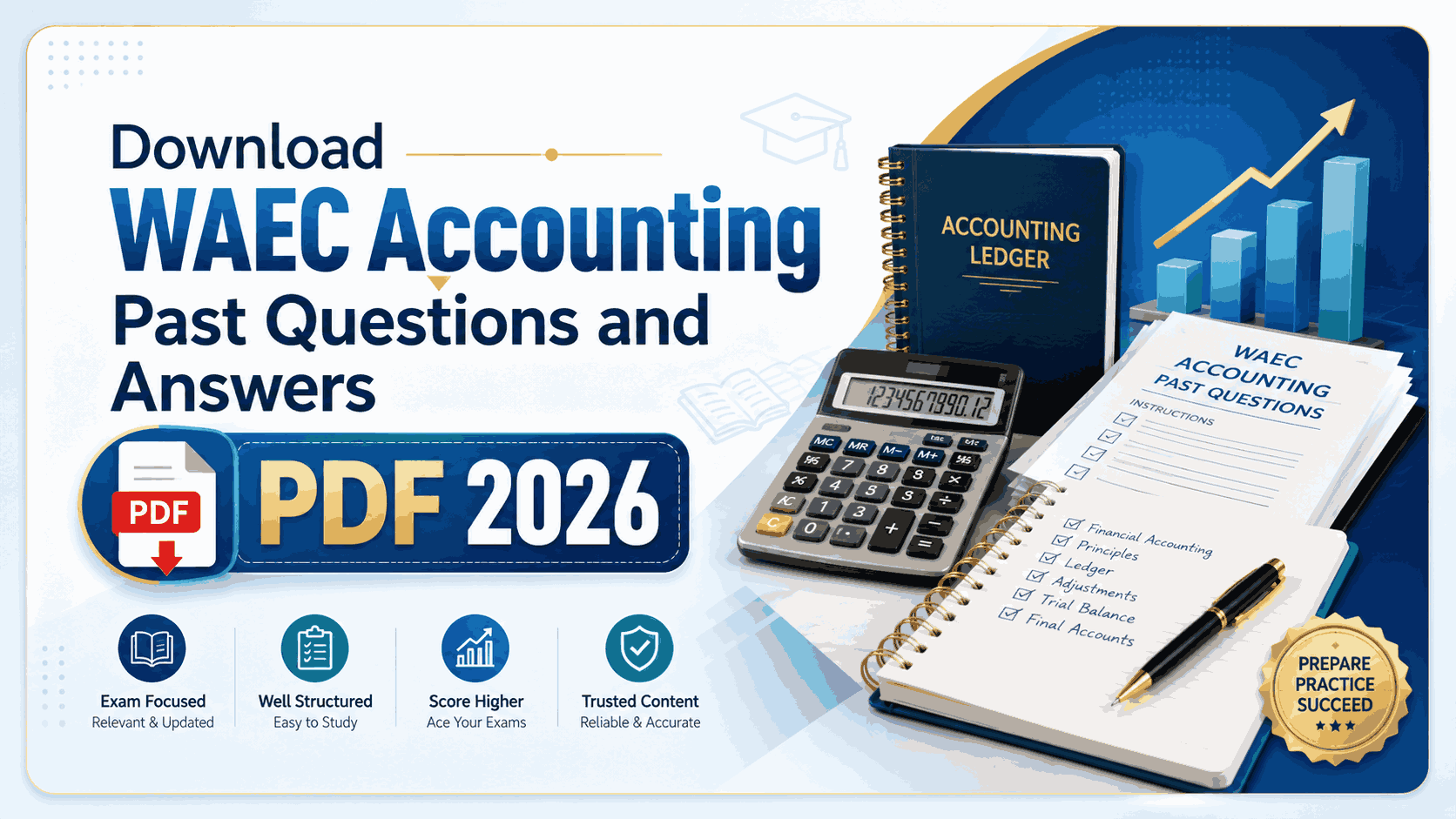

Download WAEC Accounting Past Questions and Answers PDF: Are you preparing for WAEC Accounting and looking for past questions and answers to help you study better? This guide explains how to use WAEC Accounting past questions correctly, important topics to focus on, sample practice questions, and useful revision tips for candidates.
Accounting, also known as Financial Accounting, is an important commercial subject that teaches students how to record, classify, summarize, and interpret financial transactions. It is useful for students who want to study Accounting, Banking and Finance, Business Administration, Economics, Marketing, Entrepreneurship, Public Administration, and other business-related courses.
WAEC Accounting past questions are useful because they help candidates understand the exam pattern, common question areas, and the best way to answer objective, theory, and calculation questions.
What Are WAEC Accounting Past Questions?
WAEC Accounting past questions are previous examination questions used to test students’ knowledge of bookkeeping, financial statements, ledgers, trial balance, journals, cash book, depreciation, bank reconciliation, partnership accounts, company accounts, and non-profit organization accounts.
These past questions may include:
- Objective questions
- Theory questions
- Calculation questions
- Ledger entries
- Trial balance questions
- Final accounts questions
- Cash book questions
- Bank reconciliation questions
- Partnership account questions
- Depreciation questions
Past questions help students to:
- Understand the WAEC Accounting exam format
- Know important topics that appear often
- Practise objective and theory questions
- Improve calculation speed
- Learn how to prepare financial statements
- Identify weak areas before the exam
- Build confidence before exam day
Past questions should be used for revision and practice only, not for cheating or examination malpractice.
Why Students Should Download WAEC Accounting Past Questions
Downloading or accessing WAEC Accounting past questions can help students prepare in a more organized way. Accounting is a practical subject that requires constant practice, especially in areas such as double entry, ledger accounts, trial balance, cash book, final accounts, and bank reconciliation.
When candidates practise Accounting past questions regularly, they become familiar with:
- WAEC question styles
- Common accounting formats
- Calculation methods
- Ledger posting
- Debit and credit rules
- Preparation of financial statements
- Repeated topic areas
- Time management during the exam
However, students should not depend on past questions alone. They should also study their Accounting textbook, class notes, worked examples, accounting formats, and the official syllabus.
Download WAEC Accounting Past Questions and Answers PDF | Important Topics in WAEC Accounting
Below are major topics candidates should study while preparing for WAEC Accounting.
1. Meaning and Purpose of Accounting
This is one of the foundation topics in Accounting. Students should understand what accounting means and why it is important.
Important areas include:
- Meaning of accounting
- Meaning of bookkeeping
- Difference between accounting and bookkeeping
- Objectives of accounting
- Users of accounting information
- Importance of accounting
- Branches of accounting
- Accounting concepts and conventions
Accounting helps businesses keep proper records, measure profit or loss, control resources, and make better financial decisions.
2. Accounting Concepts and Conventions
Accounting concepts are basic rules that guide the preparation of financial records.
Students should study:
- Business entity concept
- Going concern concept
- Money measurement concept
- Historical cost concept
- Matching concept
- Accrual concept
- Consistency concept
- Prudence concept
- Materiality concept
- Realization concept
These concepts help accountants prepare reliable and understandable financial statements.
3. Source Documents
Source documents are original records that provide evidence of business transactions.
Important examples include:
- Invoice
- Receipt
- Credit note
- Debit note
- Cheque
- Paying-in slip
- Statement of account
- Purchase order
- Delivery note
Students should know the meaning and use of each source document.
4. Books of Original Entry
Books of original entry are used to record transactions before they are posted to the ledger.
Important books include:
- Sales journal
- Purchases journal
- Returns inward journal
- Returns outward journal
- Cash book
- General journal
Candidates should understand when and how each book is used.
5. Double Entry Principle
Double entry is one of the most important topics in Accounting. It means that every transaction affects at least two accounts.
Students should study:
- Debit and credit rules
- Assets
- Liabilities
- Capital
- Revenue
- Expenses
- Ledger accounts
- Posting transactions
- Balancing accounts
A good understanding of double entry makes other Accounting topics easier.
6. Ledger Accounts
The ledger is the main book where accounts are recorded.
Important areas include:
- Meaning of ledger
- Types of ledger
- Sales ledger
- Purchases ledger
- General ledger
- Personal accounts
- Real accounts
- Nominal accounts
- Posting to ledger
- Balancing ledger accounts
7. Trial Balance
A trial balance is prepared to check the arithmetical accuracy of ledger accounts.
Students should study:
- Meaning of trial balance
- Purpose of trial balance
- Format of trial balance
- Debit balances
- Credit balances
- Errors revealed by trial balance
- Errors not revealed by trial balance
- Suspense account
A trial balance helps to detect some accounting errors, but it does not detect all errors.
8. Cash Book
The cash book records cash and bank transactions.
Important areas include:
- Single-column cash book
- Two-column cash book
- Three-column cash book
- Cash discount
- Trade discount
- Contra entries
- Petty cash book
- Imprest system
- Balancing the cash book
Students should practise cash book questions often because they are common in examinations.
9. Bank Reconciliation Statement
Bank reconciliation explains the difference between the cash book balance and the bank statement balance.
Students should study:
- Meaning of bank reconciliation
- Purpose of bank reconciliation
- Unpresented cheques
- Uncredited cheques
- Bank charges
- Direct deposits
- Standing orders
- Dishonoured cheques
- Errors in cash book
- Errors in bank statement
- Preparation of bank reconciliation statement
10. Final Accounts of a Sole Trader
Final accounts show the financial performance and position of a business.
Important areas include:
- Trading account
- Profit and loss account
- Income statement
- Statement of financial position
- Balance sheet
- Gross profit
- Net profit
- Opening stock
- Closing stock
- Purchases
- Sales
- Expenses
- Assets and liabilities
Final accounts are very important in WAEC Accounting and require regular practice.
11. Adjustments in Final Accounts
Students should understand how to treat common adjustments.
Important adjustments include:
- Closing stock
- Accrued expenses
- Prepaid expenses
- Accrued income
- Income received in advance
- Depreciation
- Bad debts
- Provision for doubtful debts
- Drawings
- Goods taken by owner
- Carriage inward
- Carriage outward
12. Depreciation
Depreciation is the reduction in the value of fixed assets over time.
Students should study:
- Meaning of depreciation
- Causes of depreciation
- Importance of depreciation
- Straight-line method
- Reducing balance method
- Depreciation expenses
- Accumulated depreciation
- Disposal of fixed assets
13. Control Accounts
Control accounts are summary accounts used to check the accuracy of ledgers.
Important areas include:
- Sales ledger control account
- Purchases ledger control account
- Total debtors account
- Total creditors account
- Purpose of control accounts
- Format of control accounts
- Errors in control accounts
14. Partnership Accounts
Partnership accounts deal with businesses owned by two or more partners.
Students should study:
- Meaning of partnership
- Partnership agreement
- Capital accounts
- Current accounts
- Appropriation account
- Interest on capital
- Interest on drawings
- Partners’ salaries
- Sharing of profit and loss
- Admission of a partner
- Retirement of a partner
- Dissolution of partnership
15. Company Accounts
Company accounts are important for students studying business and accounting.
Important areas include:
- Meaning of company
- Shares
- Debentures
- Ordinary shares
- Preference shares
- Share capital
- Issuing of shares
- Profit and loss appropriation account
- Reserves
- Dividends
- Financial statements of companies
16. Non-Profit Organization Accounts
Non-profit organizations are not mainly formed to make profit.
Students should study:
- Meaning of non-profit organization
- Receipts and payments account
- Income and expenditure account
- Subscription
- Donation
- Entrance fees
- Accumulated fund
- Statement of affairs
- Differences between receipts and payments account and income and expenditure account
Examples include clubs, societies, churches, mosques, associations, and charities.
17. Manufacturing Accounts
Manufacturing accounts are prepared by businesses that produce goods.
Important areas include:
- Meaning of manufacturing account
- Direct materials
- Direct labour
- Direct expenses
- Prime cost
- Factory overheads
- Work-in-progress
- Cost of production
- Trading account for manufactured goods
18. Public Sector Accounting
Public sector accounting deals with government revenue and expenditure.
Students should study:
- Meaning of public sector accounting
- Sources of government revenue
- Government expenditure
- Budget
- Capital expenditure
- Recurrent expenditure
- Consolidated Revenue Fund
- Financial control in government
- Differences between public sector and private sector accounting
How to Use WAEC Accounting Past Questions Effectively
Past questions are useful, but students must use them correctly.
1. Start With the Syllabus
Before answering past questions, go through the WAEC Accounting syllabus. The syllabus helps you know the areas you are expected to study.
2. Learn Debit and Credit Rules
Debit and credit rules are the foundation of Accounting. Without them, it will be difficult to understand ledger accounts and final accounts.
A simple rule is:
- Debit the receiver, credit the giver
- Debit what comes in, credit what goes out
- Debit expenses and losses, credit income and gains
3. Practise Formats Regularly
Accounting requires correct formats. Practise the format for:
- Ledger accounts
- Trial balance
- Cash book
- Bank reconciliation statement
- Trading account
- Profit and loss account
- Balance sheet
- Partnership account
- Income and expenditure account
4. Solve Questions Step by Step: Do not jump to answers. Read the question carefully, identify the required account, arrange the figures, and show your workings.
5. Practise Calculations Daily: Accounting improves with regular practice. Try to solve calculations every day, especially final accounts, depreciation, cash book, and bank reconciliation questions.
6. Review Your Mistakes: After answering past questions, check your mistakes and revise the topic you did not understand well.
Sample WAEC Accounting Practice Questions
Below are simple practice-style questions for revision. These are not live WAEC questions. They are only for study purposes.
Objective Practice Questions
- The process of recording business transactions is called:
A. Advertising
B. Bookkeeping
C. Transportation
D. Insurance
Answer: B. Bookkeeping
- The book used to record cash and bank transactions is called:
A. Sales journal
B. Purchases journal
C. Cash book
D. Ledger
Answer: C. Cash book
- The accounting concept that separates the owner from the business is:
A. Going concern concept
B. Business entity concept
C. Matching concept
D. Prudence concept
Answer: B. Business entity concept
- A trial balance is prepared to check:
A. Profit only
B. Cash only
C. Arithmetical accuracy
D. Sales only
Answer: C. Arithmetical accuracy
- Depreciation means:
A. Increase in asset value
B. Reduction in asset value
C. Increase in capital
D. Increase in sales
Answer: B. Reduction in asset value
Theory Practice Questions
- Define Accounting and state five users of accounting information.
- Explain five accounting concepts.
- State five source documents and their uses.
- Explain the double entry principle.
- Prepare a simple cash book from given transactions.
- State five causes of disagreement between cash book and bank statement.
- Explain four methods of calculating depreciation.
- State five differences between receipts and payments account and income and expenditure account.
Simple Accounting Calculation Example
Question: A business bought a machine for ₦500,000. Depreciation is charged at 10% per annum using the straight-line method. Calculate the annual depreciation.
Solution: Annual depreciation = Cost of asset × Rate of depreciation
Annual depreciation = ₦500,000 × 10/100
Annual depreciation = ₦50,000
Answer: ₦50,000
This method is correct because it shows the formula, substitution, and final answer clearly.
Also Read: Download WAEC Mathematics Past Questions and Answers PDF 2026
How to Answer WAEC Accounting Questions
To answer Accounting questions correctly, follow these tips:
- Read the question carefully.
- Identify the account or statement required.
- Use the correct accounting format.
- Show your workings clearly.
- Write figures neatly.
- Balance accounts properly.
- Use correct headings.
- Check totals before submitting.
For example, if a question asks you to prepare a trading account, do not include expenses like rent and salaries in the trading account. Those belong to the profit and loss account.
Common Mistakes Students Make in WAEC Accounting
Many candidates lose marks because of simple mistakes. Avoid the following:
- Not understanding debit and credit
- Poor ledger format
- Wrong treatment of adjustments
- Mixing up assets and liabilities
- Forgetting depreciation
- Not balancing accounts
- Poor calculation steps
- Confusing trade discount with cash discount
- Depending only on past questions
- Depending on fake exam answers
Accounting becomes easier when students understand the principles and practise regularly.
Benefits of Practising WAEC Accounting Past Questions
Practising Accounting past questions helps students to:
- Understand the exam format
- Know common topics
- Improve calculation skills
- Learn correct accounting formats
- Practise ledger entries
- Build confidence
- Manage exam time
- Identify weak areas before the exam
Past questions are helpful, but candidates should also study textbooks, class notes, worked examples, and the syllabus.
Can WAEC Repeat Accounting Questions?
WAEC may test similar topics from previous years, but candidates should not depend on exact repeated questions. Questions may appear in a different form even when the topic is the same.
For example, bank reconciliation can be asked through theory, calculation, cash book adjustment, or preparation of a reconciliation statement. If you understand the topic, you can answer any version of the question.
Warning Against Fake WAEC Accounting Answers
Students should be careful of people who claim to sell:
- WAEC Accounting expo
- Live Accounting answers
- Confirmed questions before the exam
- Miracle centre answers
- Guaranteed WAEC success
These claims are unsafe and unreliable. The best way to pass Accounting is to study early, understand formats, practise calculations, and answer past questions honestly.
This article is for study and revision only. It does not provide live exam answers or examination malpractice materials.
Frequently Asked Questions
Where can I download WAEC Accounting past questions and answers?
You can access WAEC Accounting past questions from teachers, approved bookshops, school libraries, trusted educational websites, and legal study platforms.
Are WAEC Accounting past questions useful?
Yes. They help students understand the exam format, practise calculations, and prepare better.
Can I pass Accounting by reading only past questions?
Past questions are helpful, but they are not enough. You should also study your textbook, class notes, worked examples, accounting formats, and the syllabus.
Does WAEC repeat Accounting questions?
WAEC may test similar topics, but students should not depend on exact repeated questions. Understanding the topics and formats is better.
Why do students fail WAEC Accounting?
Some students fail because they do not understand debit and credit rules, use wrong formats, ignore adjustments, make calculation errors, or depend on fake exam answers.
How can I pass WAEC Accounting?
Study the syllabus, learn debit and credit rules, practise accounting formats, solve calculations regularly, answer past questions, and avoid fake answers.
Is Accounting important for commercial students?
Yes. Accounting is important for students interested in Accounting, Banking and Finance, Business Administration, Economics, Entrepreneurship, and other business-related courses.
Conclusion
WAEC Accounting past questions and answers are very useful for students preparing for the examination. They help candidates understand the exam pattern, revise important topics, improve calculation skills, and learn correct accounting formats.
To perform well in Accounting, students should study the syllabus, understand debit and credit rules, practise ledger accounts, prepare financial statements, solve calculations, and avoid fake exam answers.
Success in WAEC Accounting comes from early preparation, regular practice, clear understanding, and honest study.
Disclaimer: This article is for educational and revision purposes only. We are not WAEC, and we do not provide live exam answers, expo, or examination malpractice materials. Students should use only legal and trusted study resources when preparing for their examination.