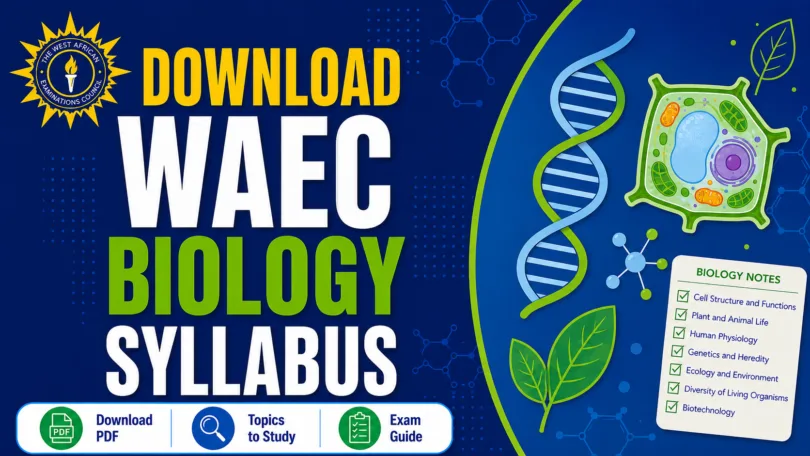

Download WAEC Biology Syllabus 2026/2027:- is one of the most searched phrases by students preparing for the forthcoming West African Senior School Certificate Examination. If you are writing WAEC next year, understanding the official Biology syllabus is one of the smartest ways to pre pare effectively and score high in the subject.
The WAEC Biology Syllabus 2026/2027 contains all the approved topics, practical areas, living organism concepts, cell biology sections, ecology focus areas, genetics topics, evolution, reproduction, nutrition, respiration, and recommended textbooks candidates are expected to study before the examination.
Many students fail Biology not because it is too difficult, but because they prepare without knowing the exact areas WAEC expects. That is why using the official syllabus gives candidates an advantage.
In this guide, you will see:
- WAEC Biology Syllabus 2026/2027
- Complete topics to study
- Objectives of the syllabus
- Recommended textbooks
- How to download WAEC Biology syllabus PDF
- Tips to pass WAEC Biology
What is WAEC Biology Syllabus?
The WAEC Biology Syllabus is an official academic guide released to help candidates know the specific areas they need to prepare for in the examination.
It focuses on major sections such as:
- Concept of Living
- Organization of Life
- Cell Biology
- Nutrition and Transport
- Respiration and Excretion
- Reproduction and Growth
- Ecology
- Genetics and Evolution
- Practical Biology
The WAEC Biology syllabus is designed to assess candidates’ understanding of living organisms, their structures, functions, relationships with the environment, and their ability to carry out laboratory and field work.
If you understand these sections well, your chances of passing Biology become very high.
WAEC Biology Syllabus 2026/2027 Full Topics to Read
A. Concept of Living
Candidates should study:
- Meaning of living things
- Differences between living and non-living things
- Characteristics of living organisms
- Classification of living organisms
- Kingdoms of living organisms
- Binomial nomenclature
- Viruses and their characteristics
- Importance of classification
Students should understand meanings, examples, features, and applications.
B. Organization of Life
You are expected to study:
- Levels of organization of life
- Cell
- Tissue
- Organ
- System
- Organism
- Complexity of organization in higher organisms
- Advantages of division of labour in organisms
- Examples of organs and systems in plants and animals
This section helps students understand how living organisms are built from simple to complex levels.
C. The Cell as a Living Unit
This section covers topics such as:
- Cell structure
- Plant and animal cells
- Functions of cell organelles
- Differences between plant and animal cells
- Microscope and its uses
- Cell division
- Mitosis and meiosis
- Diffusion
- Osmosis
- Plasmolysis
- Turgidity
Students should practice drawing and labeling plant and animal cells clearly.
D. Nutrition in Plants and Animals
Candidates should study:
- Modes of nutrition
- Autotrophic and heterotrophic nutrition
- Photosynthesis
- Conditions necessary for photosynthesis
- Mineral requirements in plants
- Food substances
- Balanced diet
- Digestive system in humans
- Digestive enzymes
- Dentition
- Feeding habits in animals
- Malnutrition and deficiency diseases
Examples:
- Functions of carbohydrates, proteins, fats, vitamins, and minerals
- Differences between herbivores, carnivores, and omnivores
- Importance of chlorophyll in photosynthesis
- Diseases caused by poor nutrition
E. Transport Systems
Candidates should study:
- Need for transport in organisms
- Transport in plants
- Xylem and phloem
- Transpiration
- Translocation
- Transport in animals
- Blood and its components
- Functions of blood
- Blood vessels
- Heart structure and functions
- Circulatory system
- Lymphatic system
Students should understand diagrams of the heart, blood vessels, and transport tissues in plants.
F. Respiration
This section includes:
- Meaning of respiration
- Aerobic respiration
- Anaerobic respiration
- Differences between breathing and respiration
- Respiratory organs in animals
- Gaseous exchange
- Human respiratory system
- Mechanism of breathing
- Respiration in plants
- Energy release in living organisms
Candidates should know the importance of respiration and how energy is released from food.
G. Excretion and Homeostasis
Candidates should focus on:
- Meaning of excretion
- Excretory products in plants and animals
- Excretory organs in humans
- Kidney structure and functions
- Skin as an excretory organ
- Liver and lungs in excretion
- Homeostasis
- Regulation of body temperature
- Regulation of blood sugar
- Osmoregulation
Students should practice diagrams of the kidney and skin.
H. Support and Movement
This section covers:
- Need for support in organisms
- Supporting tissues in plants
- Skeleton in animals
- Types of skeleton
- Bones and joints
- Functions of the skeleton
- Muscles and movement
- Locomotion in animals
- Tropism and taxis
Students should understand the relationship between bones, joints, and muscles.
I. Reproduction in Plants and Animals
Candidates should study:
- Asexual reproduction
- Sexual reproduction
- Reproduction in flowering plants
- Structure of a flower
- Pollination
- Fertilization
- Seed and fruit formation
- Dispersal of seeds and fruits
- Reproductive system in humans
- Menstrual cycle
- Fertilization in humans
- Pregnancy and birth control
- Sexually transmitted infections
This is an important section because WAEC often asks both theory and diagram questions from reproduction.
J. Growth and Development
This section includes:
- Meaning of growth
- Measurement of growth
- Growth curve
- Germination of seeds
- Conditions necessary for germination
- Metamorphosis in insects
- Development in animals
- Factors affecting growth
Students should understand examples of complete and incomplete metamorphosis.
K. Ecology
Candidates should study:
Meaning of ecology
- Habitat
- Population
- Community
- Ecosystem
- Biotic and abiotic factors
- Food chain
- Food web
- Energy flow
- Ecological pyramid
- Nutrient cycling
- Carbon cycle
- Water cycle
- Nitrogen cycle
- Population studies
- Adaptation of organisms
- Pollution and conservation
Ecology is one of the most important areas in WAEC Biology.
L. Genetics and Evolution
Candidates should study:
- Meaning of heredity
- Genes and chromosomes
- Dominant and recessive traits
- Genotype and phenotype
- Monohybrid inheritance
- Blood groups
- Sex determination
- Variation
- Mutation
- Evolution
- Natural selection
- Adaptation and survival
Students should practice simple genetic crosses and understand inheritance patterns.
M. Practical Biology
Candidates should study:
- Use of microscope
- Biological drawings
- Identification of specimens
- Food tests
- Testing for starch, protein, fat, and reducing sugar
- Observation of plant and animal tissues
- Ecology field work
- Measurement and recording of biological data
- Classification of specimens
- Labelling biological diagrams
- Safety in the laboratory
Examples:
- Drawing plant and animal cells
- Identifying insects, leaves, roots, fruits, and seeds
- Testing food samples
- Observing organisms in their habitats
- Comparing specimens based on visible features
Objectives of WAEC Biology Syllabus
The syllabus is designed to help students:
- Understand the structure and functions of living organisms
- Develop laboratory and field skills
- Classify and interpret biological data
- Explain relationships between organisms and their environment
- Understand genetics, heredity, and variation
- Apply biological knowledge to health, agriculture, and daily life
- Develop scientific observation and drawing skills
- Prepare confidently for objective, essay, and practical examinations
The WAEC Biology syllabus includes Papers 1, 2, and 3, covering objective, essay, and practical work.
Recommended Textbooks for WAEC Biology
Students can use:
- Modern Biology for Senior Secondary Schools
- Essential Biology for Senior Secondary Schools
- New School Biology
- Comprehensive Biology for Senior Secondary Schools
- Exam Focus Biology
- WAEC Biology Past Questions and Answers
- Biology Practical Manual
How to Download WAEC Biology Syllabus 2026/2027 PDF
Click the button below to download the syllabus PDF:
Download WAEC Biology Syllabus 2026/2027 PDF
You can also download the syllabus by following these steps:
- Visit the official WAEC website
- Open the syllabus section
- Search for Biology
- Download the PDF copy
- Save it on your phone or computer
- Print it out for easier reading
Important Note
Biology is an important science subject in WAEC. A good grade in Biology increases your chances of gaining admission into courses such as:
- Medicine and Surgery
- Nursing
- Pharmacy
- Medical Laboratory Science
- Microbiology
- Biochemistry
- Anatomy
- Physiology
- Agriculture
- Animal Science
- Public Health
- Environmental Science
- Education Biology
Also Check:-Download WAEC Chemistry Syllabus 2026/2027 PDF
Conclusion
The WAEC Biology Syllabus 2026/2027 PDF Download is an essential guide for every serious candidate. Instead of studying without direction, use the syllabus to focus on the exact topics WAEC wants. Students who prepare with the syllabus often perform better because they study smartly.
Since Biology is scheduled for Tuesday, 16th June 2026, candidates should start early, remain dedicated, revise consistently, and practice both theory and practical questions before the exam.
Frequently Asked Questions (FAQs)
Is WAEC Biology Syllabus for 2026/2027 Out?
Yes, the WAEC Biology syllabus is available and follows the current WAEC curriculum guide. Candidates are advised to use the latest syllabus so they can focus on approved topics, practical areas, and important sections expected in the examination.
Is Biology compulsory in WAEC?
Biology is not compulsory for all candidates, but it is very important for science students, especially those planning to study medicine, nursing, pharmacy, agriculture, microbiology, and other science-related courses.
Can I pass WAEC Biology without a lesson teacher?
Yes, it is possible to pass WAEC Biology without attending extra lessons if you are disciplined and committed. You can prepare successfully through self-study by using the syllabus, recommended textbooks, class notes, practical manuals, and past questions.
Which part carries the highest marks in WAEC Biology?
All papers are important. Biology Paper 1 is objective, Paper 2 is essay, and Paper 3 is practical. The syllabus states that Paper 1 carries 50 marks, Paper 2 carries 70 marks, and Paper 3 carries 80 marks.
Where can I get WAEC Biology past questions?
You can get WAEC Biology past questions from bookstores, tutorial centres, educational websites, school libraries, and trusted online learning platforms. Practicing past questions helps candidates understand the exam format, common topics, and repeated question patterns.
How can I score A1 in WAEC Biology?
To score A1 in WAEC Biology, study the syllabus carefully, understand key concepts, practice biological drawings, revise practical specimens, master definitions, and solve past questions regularly. Good time management during the exam is also very important.
Is WAEC Biology difficult?
No, WAEC Biology is not difficult if you prepare properly. With regular study, clear understanding of concepts, practical revision, and consistent practice, the subject is very passable.