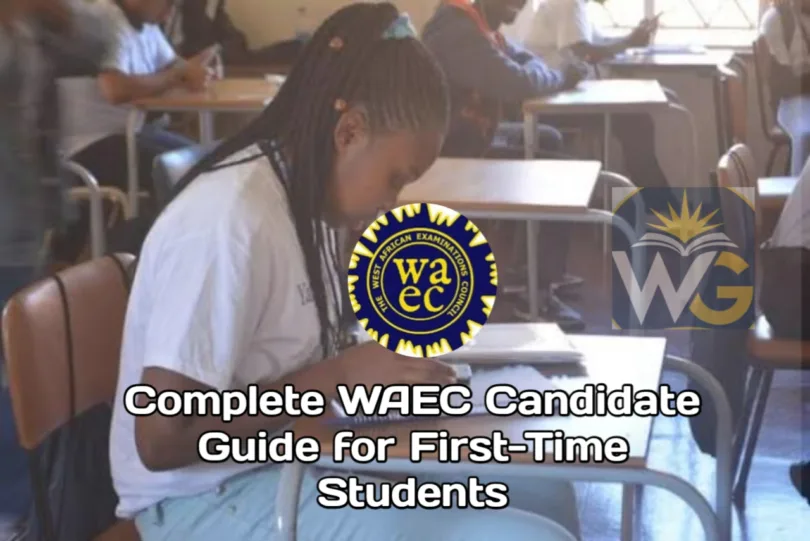

Complete WAEC Candidate Guide for First-Time Students:Starting WAEC for the first time can feel overwhelming. You may have questions about registration, subject selection, examination requirements, preparation, examination-day rules, grading, result checking and what happens after the examination.
The good news is that you do not have to figure everything out by yourself.
The West African Examinations Council (WAEC) examination is an important academic milestone for many secondary school students in Nigeria and other participating West African countries. Understanding how the examination works before you sit for it can help you avoid common mistakes and approach the examination with greater confidence.
This complete guide is designed for first-time WAEC candidates. It covers the important stages from registration to result checking and explains what students should know before entering the examination hall.
Whether you are currently preparing for WAEC, about to register, or simply want to understand what to expect, this guide provides a practical overview.
What Is WAEC?
WAEC stands for the West African Examinations Council.
It is the examination body responsible for conducting several examinations across participating West African countries.
In Nigeria, one of the most important examinations conducted by WAEC is the West African Senior School Certificate Examination (WASSCE).
Students who complete senior secondary education commonly sit for WASSCE as part of their secondary-school qualification.
What Is WASSCE?
WASSCE means West African Senior School Certificate Examination.
It assesses candidates in subjects they have registered for and provides grades that can be used for further education and other purposes.
The examination is generally associated with two broad candidate categories:
- School candidates.
- Private candidates.
The registration process, examination arrangements and eligibility can differ between these categories.
Who Can Write WAEC?
WAEC examinations are available to eligible candidates according to the particular examination category.
School candidates usually register through their secondary schools.
Private candidates register individually through the procedures provided for that examination.
If you are a first-time candidate, ask your school or check the official WAEC information for the examination you intend to write before registration.
WAEC for School Candidates
School candidates are students who register through an approved secondary school.
The school usually coordinates important parts of the registration process.
This can include:
- Subject selection.
- Candidate information.
- Registration.
- Examination centre arrangements.
- Photocard or registration documentation.
- Communication about examination dates.
- Examination instructions.
Although the school assists with registration, candidates should still check their personal information carefully.
WAEC for Private Candidates
Private candidates register independently rather than through a regular school candidate process.
This option may be available to people who are not currently attending secondary school or who want to sit for the examination independently.
Private candidates should carefully follow the official registration instructions for the relevant examination diet.
What You Should Know Before Registering for WAEC
Before registration begins, understand the requirements of your examination.
Do not rush through registration simply because other students are registering.
Pay attention to:
- Your personal information.
- Subjects.
- Examination category.
- Registration deadline.
- Examination centre.
- Required identification information.
- Payment requirements.
- Photocard information.
An error made during registration can cause difficulties later.
WAEC Registration Process
The exact registration process can vary depending on whether you are a school or private candidate and the examination year.
However, the general process involves providing your personal information, selecting subjects and completing the required registration procedures.
Provide Your Correct Name
Your name should be entered carefully.
Check:
- Spelling.
- Order of names.
- Middle names.
- Surname.
Do not casually use a nickname.
Your examination records may later be used for admission and other official purposes.
Provide Correct Date of Birth
Enter your date of birth exactly as required.
Avoid guessing.
If you discover an error after registration, report it through the appropriate official process rather than ignoring it.
Choose Your Subjects Carefully
Subject selection is one of the most important parts of WAEC registration.
Your subjects should be relevant to your intended future course where possible.
For example, students interested in science-related university programmes generally need appropriate science subjects.
Students interested in Arts or Social Science programmes should also consider the requirements of their intended courses.
Keep Your Registration Details
After registration, keep copies of your relevant registration documents.
Do not throw them away after registration.
You may need information from them later when:
- Preparing for the examination.
- Printing documents.
- Checking your result.
- Applying for admission.
- Recovering forgotten examination information.
How Many Subjects Should You Register for?
The number of subjects available or required can depend on the examination category and current WAEC rules.
Rather than relying on an old number from another candidate, follow the subject and registration instructions for your examination year.
More importantly, make sure the subjects you choose satisfy your intended academic pathway.
WAEC Subject Combination for Future Courses
First-time candidates should think beyond the examination itself.
If you already know what you want to study after secondary school, research its O’Level subject requirements before registering.
For example, someone planning to study Medicine should consider the required science subjects.
Someone interested in Engineering should pay close attention to Mathematics and relevant science subjects.
A student interested in Law should ensure that the appropriate O’Level subjects are included.
Do not choose subjects simply because your friends are taking them.
Why Subject Selection Matters
A good WAEC result is important, but the right subjects are equally important.
You could obtain excellent grades and still experience admission difficulties if you do not have the required subjects for your chosen course.
Therefore, ask:
- What course do I want to study?
- Which university or institution interests me?
- What O’Level subjects does the course require?
- Does the institution accept one sitting or two?
- Are there specific grades I need?
WAEC Examination Timetable
The WAEC timetable tells you when and where your examinations will take place.
As soon as the official timetable becomes available, study it carefully.
Write down:
- Subject.
- Date.
- Day.
- Time.
- Paper.
- Practical examination date where applicable.
Don’t Depend Only on Your Friends for the Timetable
Always keep your own copy of the timetable.
A friend can accidentally give you incorrect information.
Use the official timetable or the version supplied by your school.
Check for Practical Examinations
Some subjects include practical examinations.
Do not assume that the practical will take place on the same day as the theory paper.
Check the timetable carefully.
How to Prepare for WAEC as a First-Time Candidate
Good preparation should begin long before the final examination week.
Create a Study Timetable
A study timetable helps you divide your available time among your subjects.
Your timetable should include:
- Difficult subjects.
- Easier subjects.
- Revision periods.
- Practice questions.
- Breaks.
- Sleep.
Do not create a timetable that is impossible to follow.
A simple timetable that you actually follow is better than a complicated timetable that you abandon after three days.
Identify Your Weak Subjects
Do not spend all your study time on subjects you already understand.
Identify areas where you struggle.
For example:
- Mathematics calculations.
- Chemistry equations.
- Physics formulas.
- English essay writing.
- Biology diagrams.
Give these areas additional attention.
Use the WAEC Syllabus
The syllabus helps you understand the areas that may be covered in a subject.
Use it as a checklist.
Instead of simply reading randomly, work through the topics systematically.
Practise Past Questions
Past questions are valuable because they help you become familiar with examination-style questions.
When practising, don’t just memorize answers.
Try to understand:
- How questions are structured.
- How marks may be allocated.
- What topics repeatedly require practice.
- How to manage time.
Practise Under Time Limits
Knowing an answer is not enough.
You must also be able to complete the paper within the available time.
Occasionally practise full papers under examination conditions.
Turn off distractions and work within the actual time limit.
How Many Hours Should You Study for WAEC?
There is no universal number of hours that guarantees success.
The quality and consistency of your study are more important than simply counting hours.
A focused two-hour study session can be more useful than five hours of distracted reading.
Create a routine that you can maintain.
Take Breaks
Your brain needs rest.
Use short breaks between study sessions.
Avoid staying awake throughout the night repeatedly because you believe that sleeping less automatically means studying more.
How to Study Difficult WAEC Subjects
Different subjects require different approaches.
Mathematics
Practise problems repeatedly.
Do not only read worked examples.
Try solving questions yourself.
Physics
Understand formulas and concepts instead of memorizing formulas without understanding what they mean.
Practise calculations and application questions.
Chemistry
Combine theory with calculations, equations, reactions and practical knowledge.
Biology
Understand processes, definitions, diagrams and relationships between concepts.
English Language
Practise comprehension, summary, grammar, vocabulary and writing.
Literature
Read the prescribed texts carefully and understand characters, themes, settings, events and literary techniques.
How to Prepare for WAEC Practical Examinations
If your subject has a practical component, begin preparing early.
Learn:
- Names of apparatus.
- Functions of apparatus.
- Safety precautions.
- Experimental procedures.
- How to record observations.
- How to interpret results.
Do not wait until the night before the practical examination.
What to Take to the WAEC Examination Hall
The exact items permitted can depend on the subject and official instructions.
Generally, candidates should prepare the permitted examination materials in advance.
These may include:
- Required writing materials.
- Approved mathematical instruments where applicable.
- Examination photocard or required identification document.
- Other items specifically permitted for the examination.
Always follow the instructions given by WAEC and your school.
What Not to Take Into the Examination Hall
Do not bring prohibited materials.
Examples of potentially prohibited items include:
- Mobile phones.
- Unauthorized electronic devices.
- Written notes.
- Unauthorized textbooks.
- Communication devices.
- Any material specifically prohibited by examination instructions.
If you are uncertain about an item, ask your school or examination supervisor before the examination.
Why Phones Are a Serious Examination Risk
Candidates sometimes think they can secretly keep a phone in their pocket or bag.
This is a bad idea.
Even if you do not intend to use it, having a prohibited device can create serious problems.
Follow the examination rules.
Leave prohibited items at home or in the location designated by the examination centre.
What Happens When You Arrive at the Examination Centre?
Arrive early.
Do not wait until the last minute.
When you arrive:
- Confirm your examination venue.
- Check the candidate information.
- Listen to instructions.
- Locate your seat.
- Prepare your permitted materials.
- Remain calm.
Avoid unnecessary arguments or distractions before the paper begins.
How to Behave in the Examination Hall
Once inside the hall, follow the instructions of the invigilators.
Do not:
- Talk to other candidates.
- Exchange materials without permission.
- Copy another candidate.
- Use unauthorized notes.
- Use prohibited electronic devices.
- Disturb other candidates.
If you have a problem, raise your hand and speak to the invigilator.
How to Answer WAEC Questions
Read the instructions before answering.
Do not immediately start writing because you are anxious.
Read the Entire Question
Understand exactly what the question is asking.
Pay Attention to Command Words
Words such as:
- Explain.
- State.
- List.
- Describe.
- Compare.
- Discuss.
- Calculate.
can require different types of answers.
Show Your Working
For calculation-based subjects, show relevant steps.
Even when you make an arithmetic mistake, properly presented working can sometimes demonstrate your method.
Manage Your Time
Do not spend most of the examination on one difficult question.
If you are stuck, move on and return later if time permits.
How to Answer WAEC Essay Questions
For essay questions, organize your response.
Where appropriate:
- Understand the topic.
- Plan your points.
- Write clearly.
- Use paragraphs.
- Answer the question directly.
- Support your points with relevant explanations.
Avoid filling pages with information that does not answer the question.
How to Manage Time During WAEC
Before starting, estimate how much time you can spend on different sections.
For objective papers, avoid spending too long on one question.
For theory papers, divide your time according to the marks and number of questions.
Keep some time at the end to review your work.
What If You Don’t Know an Answer?
Do not panic.
Move to the questions you know.
For objective questions, follow the examination instructions carefully.
For theory questions, provide a relevant answer based on what you understand.
Do not leave a question blank simply because you cannot remember the perfect wording if you can provide relevant information.
How WAEC Is Graded
WAEC uses grades to represent candidates’ performance.
The commonly recognized WASSCE grading scale includes:
| Grade | General interpretation |
|---|---|
| A1 | Excellent |
| B2 | Very Good |
| B3 | Good |
| C4 | Credit |
| C5 | Credit |
| C6 | Credit |
| D7 | Pass |
| E8 | Pass |
| F9 | Fail |
The exact interpretation of grades should be considered alongside the requirements of the institution or programme to which you are applying.
What Is a Credit in WAEC?
A credit generally refers to grades from A1 to C6.
Many tertiary institutions require candidates to have credits in specific O’Level subjects.
For example, a course may require five relevant credits including English Language and Mathematics.
Always check the specific admission requirements.
Is D7 a Credit?
No.
D7 is generally classified as a pass rather than a credit.
If your course specifically requires a credit in a particular subject, D7 will normally not satisfy that requirement.
Is E8 a Credit?
No.
E8 is also generally classified as a pass rather than a credit.
Candidates should check their course requirements carefully.
Is F9 a Pass?
No.
F9 indicates failure in the subject.
If the subject is compulsory for your intended course, you may need to obtain the required grade through another accepted result.
How to Check Your WAEC Result
When WAEC releases results, candidates can use the official result-checking method available for their examination.
Depending on the current system, this may involve:
- Examination number.
- Examination year.
- Examination type.
- Result-checking PIN or voucher.
- Other required information.
Always use the official WAEC result-checking platform or authorized method.
Keep Your Candidate Number Safe
Your candidate number is important.
Do not throw away your:
- Examination photocard.
- Registration information.
- Result printout.
These documents can help you retrieve examination information later.
What If You Forget Your WAEC Candidate Number?
First check:
- Examination photocard.
- Registration documents.
- Result printout.
- Phone files.
- Email.
- School records.
If you were a school candidate, contact your school.
If you cannot recover it through your records, seek assistance through official WAEC channels.
What If Your WAEC Result Is Withheld?
Do not immediately conclude that your academic future is over.
A withheld result requires attention to the reason and any instructions provided by WAEC.
Follow official procedures and avoid people who claim they can “release” a withheld result in exchange for money.
What If You Have a Missing Subject or Poor Grade?
First identify whether the subject is required for your intended course.
If it is required, you may need to consider an accepted alternative O’Level result or rewrite the examination.
The correct solution depends on the institution and course.
Can You Use Awaiting WAEC Result for Admission?
In many cases, institutions allow candidates to apply with an awaiting O’Level result.
However, policies differ.
If your WAEC result has not yet been released:
- Check whether your institution accepts awaiting results.
- Indicate awaiting result where appropriate.
- Do not invent grades.
- Check the result once released.
- Upload or submit it according to the institution’s instructions.
Awaiting result does not mean you are permanently exempt from the O’Level requirement.
Can You Combine Two WAEC Results?
Some institutions allow candidates to combine two O’Level results, while others may have restrictions.
Before relying on a combination, check:
- Institution policy.
- Course requirements.
- Number of sittings permitted.
- Examination bodies accepted.
WAEC and University Admission
A good WAEC result can be important for university admission.
However, WAEC is only one part of the admission process.
You may also need to satisfy:
- JAMB requirements.
- UTME score requirements.
- Subject combination.
- Post-UTME or screening requirements.
- Course-specific requirements.
- Institution-specific conditions.
WAEC and Polytechnic Admission
Polytechnics also have O’Level requirements.
Candidates should check the specific requirements for their chosen National Diploma programme.
Do not assume that the requirements are identical to those of every university.
WAEC and College of Education Admission
Colleges of education also require candidates to meet specified O’Level conditions.
Check the current requirements of your preferred institution and programme.
Common Mistakes
Registering the Wrong Subjects
Choosing subjects without considering your future course can create admission problems.
Entering Incorrect Personal Information
A spelling or date-of-birth error should not be ignored.
Losing Your Registration Documents
Keep your documents safe from registration until after admission.
Waiting Until the Last Minute to Study
Starting early gives you more time to understand difficult topics.
Ignoring the Syllabus
The syllabus provides a useful framework for your preparation.
Reading Without Practising Questions
Active practice is essential.
Focusing Only on Favourite Subjects
Weak subjects require attention too.
Ignoring Practical Examinations
Practical papers should be prepared for just like theory papers.
Bringing a Phone Into the Examination Hall
Avoid prohibited devices.
Arriving Late
Plan your route and arrive early.
Spending Too Long on One Question
Manage your time.
Writing Irrelevant Answers
Answer what the question asks.
Copying Other Candidates
Do not risk your examination result.
Believing Examination Scams
Nobody should promise you guaranteed WAEC grades or an illegal result upgrade.
Throwing Away Your WAEC Documents
Keep your important examination records after the examination.
A Simple Three-Month WAEC Preparation Plan
If you have three months remaining, you can organize your preparation into phases.
Month One: Understand the Syllabus
Use the first month to cover major topics.
Focus on understanding rather than rushing.
Identify weak areas.
Month Two: Intensive Practice
Begin solving more past questions.
Time yourself.
Review mistakes.
Month Three: Revision and Mock Examinations
Revise difficult topics.
Practise complete papers.
Work under examination conditions.
Avoid learning everything from scratch during the final days.
A One-Week WAEC Preparation Strategy
During the final week, avoid panic.
Focus on:
- Revision.
- Past questions.
- Important formulas.
- Definitions.
- Difficult topics.
- Practical procedures.
- Examination requirements.
Get enough sleep.
Prepare your examination materials before examination morning.
The Night Before WAEC
Do not spend the entire night studying.
Instead:
- Review important points.
- Pack permitted materials.
- Check your timetable.
- Confirm your route.
- Set an alarm.
- Sleep at a reasonable time.
A tired candidate may struggle to concentrate.
On the Morning of WAEC
Wake up early.
Eat appropriately.
Leave home early enough to account for traffic.
Take only permitted items.
Arrive at the centre calmly.
Listen to the invigilator.
After Each WAEC Paper
Once an examination finishes, avoid spending hours arguing with classmates about every answer.
You cannot change a completed paper.
Instead, focus on the next subject.
If you made mistakes, learn from them and continue preparing.
After Completing All WAEC Papers
Once your final paper is over, keep your examination documents safely.
Then wait for the official result announcement.
Avoid websites claiming that they already know your personal result before the official release.
How to Prepare for Your WAEC Result
Before the result is released, know what you want to do next.
You may be planning:
- University admission.
- Polytechnic admission.
- College of education.
- Vocational training.
- Professional certification.
- Employment.
Understanding your next step can help you act quickly when your result becomes available.
Frequently Asked Questions
Is WAEC difficult for first-time candidates?
WAEC can be challenging, but good preparation makes it much easier to manage. Understanding the syllabus, practising past questions and developing good examination habits can significantly improve your preparation.
What should I do first when preparing for WAEC?
Start by understanding your subjects and syllabus. Then create a realistic study timetable and identify your weakest areas.
How many hours should I study for WAEC?
There is no fixed number of hours that guarantees success. Focus on consistent, distraction-free study and take adequate breaks.
Can I pass WAEC without reading every day?
It is possible for students to perform differently based on their preparation, but consistent study is generally a much better strategy than relying on last-minute reading.
Should I study past questions for WAEC?
Yes. Past questions can help you understand examination patterns, practise answering questions and improve time management.
Are WAEC past questions enough?
No. Past questions should complement your textbooks, class notes, syllabus and other reliable learning materials.
Can I use a calculator in WAEC?
This depends on the subject and the current examination rules. Use only calculators and other materials permitted for the particular paper.
Can I take my phone into the WAEC examination hall?
Candidates should follow WAEC’s rules regarding prohibited electronic devices. Do not take a prohibited phone into the examination hall.
What happens if I am late for WAEC?
Being late can create serious problems. Plan your journey carefully and arrive at the examination centre early.
What should I take to the WAEC examination?
Take the permitted writing materials and any required identification or examination documents. Follow your school’s and WAEC’s instructions.
Can I change my WAEC subjects after registration?
Subject changes are controlled by the applicable registration rules. Do not assume you can change subjects whenever you want. Speak to your school or follow the official procedure.
Can I change my WAEC examination centre?
Centre changes are subject to WAEC rules and the circumstances of the examination. Do not assume that you can simply choose another centre after registration.
Can I register for WAEC as a private candidate?
Yes, WAEC conducts examinations for private candidates under applicable registration procedures. Check the current official requirements before registering.
Can I use awaiting WAEC result for admission?
Many institutions allow awaiting results, but this depends on the institution and programme. You will eventually need to provide a valid O’Level result that satisfies the admission requirements.
How can I check my WAEC result?
Use the official WAEC result-checking method available for your examination. You may need your examination number and a valid result-checking PIN or voucher.
Can I check WAEC result using SMS?
If an official SMS service is available for your examination, you can use it according to WAEC’s current instructions. Verify the current short code and message format before sending your details.
What happens if my WAEC result is withheld?
Follow the official instructions provided by WAEC. Do not pay unofficial individuals who promise to release or alter a withheld result.
What is the highest WAEC grade?
A1 is the highest grade in the commonly used WASSCE grading scale.
Is C6 a credit in WAEC?
Yes. C6 is generally classified as a credit.
Is D7 a credit in WAEC?
No. D7 is generally considered a pass rather than a credit.
Is E8 a credit in WAEC?
No. E8 is generally considered a pass rather than a credit.
Is F9 a pass in WAEC?
No. F9 indicates failure in the subject.
Can I combine WAEC and NECO?
Some institutions accept combinations of recognized O’Level results, but the policy varies. Check your chosen institution and programme.
Can I combine two WAEC results?
Some institutions permit two sittings, while others may impose restrictions. Check the current admission requirements.
How can I avoid failing WAEC?
Prepare early, understand your syllabus, practise past questions, attend classes, revise consistently, manage your time and follow examination rules.
What is the biggest mistake first-time WAEC candidates make?
One common mistake is underestimating the examination until it is close. Starting early gives you more time to identify and correct weaknesses.
Should I study all night before WAEC?
No. Last-minute all-night reading can leave you tired during the examination. Prepare beforehand and get adequate rest.
What should I do after WAEC?
Keep your examination documents safe, monitor official result announcements and begin preparing for your next academic or career step.
Can I use my WAEC result for university admission?
Yes. WAEC is widely used as an O’Level qualification for admission purposes, subject to the requirements of the institution and programme.
What if my WAEC result does not meet my course requirements?
Check whether another accepted O’Level result can satisfy the missing requirement or whether you need to rewrite the relevant subject. Your options depend on the institution and programme.
Conclusion
WAEC does not have to be frightening for a first-time candidate. The key is to prepare early, register carefully, choose the right subjects, study consistently, practise past questions and follow examination rules.
Keep your registration documents and candidate information safe, arrive early for every paper and avoid prohibited materials in the examination hall. After the examination, use official channels to check your result and carefully review your grades before beginning your admission process.
Most importantly, remember that WAEC is not only about passing individual subjects. Your subjects and grades can affect your future admission options, so take the examination seriously from the beginning. With proper preparation, discipline and a clear study plan, you can approach your first WAEC examination with much greater confidence.