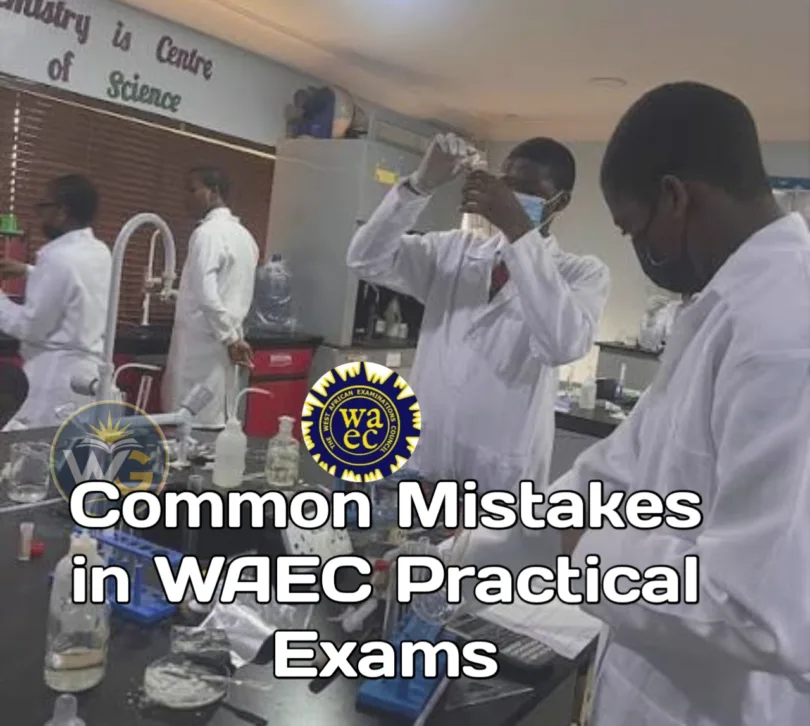

Common Mistakes in WAEC Practical Exams:WAEC practical examinations are an important part of the West African Senior School Certificate Examination for subjects that include practical assessment. Unlike objective questions, practical examinations require candidates to demonstrate how well they can apply what they have learned in actual or simulated practical situations.
Many students prepare extensively for the theory and objective papers but pay less attention to the practical examination. This can be costly because practical questions may test observation, measurement, identification, calculations, drawings, graphs, experiments, conclusions and other skills.
The good news is that many practical examination mistakes are avoidable.
Understanding the common mistakes students make can help you prepare properly and become more confident before entering the examination hall.
Whether you are preparing for WAEC Physics Practical, Chemistry Practical, Biology Practical, Agricultural Science Practical or another subject with a practical component, the principles of careful preparation, accurate observation and proper presentation remain important.
This guide explains the most common mistakes students make during WAEC practical exams, why those mistakes can cost marks and what you can do to avoid them.
Why Students Make Mistakes in WAEC Practical Exams
Practical examinations can be stressful because candidates must often perform several tasks within a limited period.
A student may have to read an instrument, record results, perform calculations, draw a graph and answer questions based on the experiment.
Pressure can cause candidates to rush.
Other students make mistakes because they memorise procedures without understanding the principles behind them.
Common causes of practical mistakes include:
- Poor preparation.
- Lack of laboratory experience.
- Failure to read instructions carefully.
- Careless measurements.
- Poor time management.
- Incorrect calculations.
- Incomplete answers.
- Fear and anxiety.
- Poor knowledge of apparatus.
- Failure to practise past questions.
- Overdependence on predicted questions.
The first step toward avoiding these problems is knowing what they are.
Not Reading the Instructions Carefully
One of the most common mistakes in practical examinations is starting the task without properly reading the instructions.
A candidate may see an apparatus or specimen and immediately begin working because they believe they already know what to do.
This can lead to unnecessary errors.
Practical questions are often structured carefully, and a small instruction can determine exactly what the examiner expects.
Before beginning, read the question and instructions carefully.
Pay attention to words such as:
- Measure.
- Determine.
- Calculate.
- Record.
- Draw.
- Identify.
- Compare.
- State.
- Describe.
- Explain.
Each command requires a particular type of response.
Rushing Through the Experiment
Another common mistake is rushing because the candidate is afraid of running out of time.
Working quickly is not necessarily the same as working efficiently.
When you rush, you may:
- Read an instrument incorrectly.
- Record the wrong value.
- Forget a unit.
- Misplace a decimal point.
- Skip a step.
- Mislabel a diagram.
- Make an incorrect observation.
Work systematically instead.
Read the instructions, organise your work and proceed carefully.
Taking Inaccurate Measurements
Measurement is extremely important in many practical examinations, particularly Physics and Chemistry.
An incorrect measurement can affect several subsequent answers.
For example, a value recorded incorrectly may later be used to:
- Plot a graph.
- Calculate a gradient.
- Determine a physical quantity.
- Compare results.
- Draw a conclusion.
Always read measuring instruments carefully.
Forgetting Units
Students sometimes record numerical values without units.
This is a simple mistake that can be avoided by checking every answer.
Examples of scientific units include:
- Metres.
- Centimetres.
- Kilograms.
- Seconds.
- Newtons.
- Joules.
- Watts.
- Volts.
- Amperes.
- Ohms.
- Degrees Celsius.
The appropriate unit depends on the quantity being measured.
Do not add random units simply because you think every answer needs one.
Use the unit appropriate to the quantity and question.
Using the Wrong Instrument
Candidates are expected to understand the functions of common laboratory and practical instruments.
Using the wrong instrument or confusing similar instruments can affect the accuracy of an experiment.
Before the examination, revise the names, functions and uses of relevant apparatus.
For Physics, this may include instruments such as:
- Metre rule.
- Ammeter.
- Voltmeter.
- Stopwatch.
- Vernier calipers.
- Micrometer screw gauge.
- Thermometer.
Chemistry candidates should also understand common laboratory apparatus and their uses.
Poor Knowledge of Apparatus
Knowing the name of an apparatus is not enough.
You should understand what it is used for and, where relevant, how it should be used.
For example, a candidate may know the name of an instrument but not understand how to take a proper reading from it.
Practical preparation should therefore involve actual exposure to laboratory equipment whenever possible.
Recording Results Carelessly
Results should be recorded immediately and clearly.
Do not depend on memory.
If you take several measurements and wait until later to record them, you may forget a value or place it in the wrong position.
Keep your results organised.
Poorly Constructed Tables
Tables are frequently used to present practical results.
A poor table can make your work difficult to follow.
A good results table should have:
- Appropriate headings.
- Correct quantities.
- Suitable units.
- Clearly arranged values.
- Consistent presentation.
For example, if a column contains measurements of length, the heading should make it clear what is being measured and the unit being used.
Inconsistent Decimal Places
In some practical measurements, students record values with inconsistent decimal places without considering the precision of the instrument.
For example, recording one measurement as 2.5 cm and another as 2.50 cm may not communicate the same level of precision.
Follow the requirements of the question and the precision appropriate to the measuring instrument.
Making Up Observations
Candidates should report what they actually observe.
One dangerous habit is changing observations because the student expects a particular result.
For example, if a chemical reaction produces an unexpected observation, do not simply write the observation you memorised from a textbook.
Record the relevant observation accurately.
If something appears unusual, check your procedure and equipment where possible.
Confusing Observation With Inference
An observation is something directly seen, measured or detected.
An inference is an explanation based on an observation.
For example, seeing bubbles during a reaction is an observation.
Saying that the bubbles indicate the production of a particular gas is an inference.
When a question asks for an observation, provide the observation rather than immediately giving an explanation.
Drawing Poor Biological Diagrams
Biology Practical candidates can lose marks through poorly drawn diagrams.
A biological drawing should communicate the structure clearly.
Avoid:
- Excessive shading.
- Very small drawings.
- Unnecessary artistic decoration.
- Incorrect proportions.
- Missing structures.
- Messy lines.
Use clear lines and include the important features required by the question.
Incorrect Labelling of Diagrams
A good drawing can still lose marks if the labels are incorrect.
Make sure each label points to the correct structure.
Label lines should be clear and should not create confusion.
Before submitting your work, check each label.
Drawing What You Expect Instead of What You See
This is particularly important in Biology Practical.
Students sometimes memorise a textbook diagram and reproduce it even when the specimen they are given looks different.
The examination may test your ability to observe the specimen provided.
Study the specimen carefully before drawing.
Your drawing should represent the features you are expected to observe.
Poor Graph Construction
Graphs are an important part of some practical examinations.
Students often lose marks because of:
- Poor scale selection.
- Incorrect axis labels.
- Missing units.
- Inaccurate plotting.
- Joining points incorrectly.
- Drawing an inappropriate line.
- Choosing unsuitable points for gradient calculation.
Take your time when constructing a graph.
Choosing a Bad Graph Scale
Your scale should make good use of the available graph space.
A scale that is too small can make points difficult to plot accurately.
A scale that is unnecessarily complicated can also make the graph difficult to use.
Choose a simple, sensible scale that allows the data to be represented clearly.
Forgetting to Label Graph Axes
Both axes should be properly identified when the question requires a graph.
Include the appropriate quantity and unit.
For example:
Time (s)
or
Distance (m)
Do not assume that the examiner will know what your axis represents.
Plotting Points Carelessly
Graph points should be plotted as accurately as possible.
A small error can affect the line of best fit and any calculation based on the graph.
Use a sharp pencil and take care with the scale.
Drawing a Line Through Every Point
A common mistake is connecting every plotted point with a series of straight lines.
If the question requires a line of best fit, the aim is to represent the overall relationship between the variables.
Follow the instructions given in the question.
Calculating the Gradient Incorrectly
Candidates may understand how to plot a graph but make mistakes when calculating the gradient.
The gradient is generally calculated as:
Gradient = Change in vertical value ÷ Change in horizontal value
When calculating a gradient from a graph, choose two suitable points on the line of best fit, particularly points that make the calculation clear.
Show your working.
Failing to Show Working
Some students write only the final numerical answer.
This makes it difficult to demonstrate how the answer was obtained.
Where a calculation is required, show the relevant formula, substitution and calculation.
This also makes it easier to identify where an error occurred.
Using the Wrong Formula
Practical calculations often require formulas learned during the theory lessons.
Students sometimes remember a formula incorrectly or use a formula for a different quantity.
Do not rely on vague memory.
Understand what each formula means and the conditions under which it is used.
Making Calculation Errors
Even when the correct formula is used, arithmetic mistakes can reduce the accuracy of the final answer.
Common errors include:
- Wrong multiplication.
- Incorrect division.
- Decimal-point errors.
- Incorrect conversion.
- Copying numbers incorrectly.
Check your calculations before moving on.
Ignoring Experimental Errors
Some practical questions ask candidates to identify possible sources of error.
Students sometimes write vague answers such as:
“Human error.”
This may not adequately explain the specific problem.
Where the question asks for a source of error, identify a relevant error associated with the experiment.
Possible examples include:
- Parallax error.
- Zero error.
- Heat loss.
- Reaction-time differences.
- Instrument limitations.
- Inaccurate readings.
The correct answer depends on the experiment.
Giving Irrelevant Precautions
Precautions should be connected to the experiment.
For example, saying “Be careful” is too general to communicate a specific precaution.
A better precaution explains what should be done and why it matters.
The exact precaution must match the practical activity.
Writing an Unrelated Conclusion
A conclusion should be based on the results obtained.
Do not write a conclusion that simply repeats a memorised statement.
Look at the results and determine what relationship or outcome they demonstrate.
Confusing Conclusion With Explanation
A conclusion tells you what the results show.
An explanation tells you why the result occurred.
If the question asks for a conclusion, answer based on the evidence from the experiment.
If it asks for an explanation, provide the relevant scientific reason.
Leaving Questions Unanswered
Some candidates become discouraged after making one mistake and leave the remaining questions blank.
Do not give up.
Attempt every question you can.
A practical paper may contain several independent tasks, so one mistake does not necessarily mean you have failed the entire examination.
Spending Too Much Time on One Question
Time management matters.
If one part is taking too long, move to another section where possible.
You can return to the difficult part later.
Avoid spending a large portion of the examination trying to perfect one small answer.
Not Checking Your Work
A candidate may finish early and immediately stop working.
Use any remaining time to review your answers.
Check:
- Measurements.
- Units.
- Tables.
- Calculations.
- Graphs.
- Diagrams.
- Labels.
- Conclusions.
- Question numbers.
You may discover simple mistakes that can still be corrected.
Poor Preparation for Practical Classes
You cannot become confident in practical examinations simply by reading theory.
Practical skills improve through practice.
If your school provides laboratory practical sessions, take them seriously.
Pay attention when your teacher demonstrates an experiment.
Ask questions when you do not understand a procedure.
Memorising Without Understanding
Memorisation has a place in examination preparation, but practical examinations require understanding.
A student may memorise a procedure but become confused when the question changes the arrangement or presents an unfamiliar specimen.
Understand:
- Why the experiment is performed.
- What is being measured.
- What variables are involved.
- What the results mean.
- What errors can occur.
- What precautions are appropriate.
Depending Too Much on Predictions
Students sometimes spend too much time searching for predicted practical questions.
Predictions can be unreliable.
A candidate who prepares only for a predicted experiment may struggle if the actual examination is different.
Use predictions, if at all, only as an additional revision aid.
Do not replace proper preparation with them.
Ignoring Past Practical Questions
Past questions can help you understand how practical questions are presented.
They can also reveal recurring skills that candidates need to practise.
Use past questions to practise:
- Graphs.
- Calculations.
- Observations.
- Drawings.
- Identification.
- Experimental procedures.
- Conclusions.
- Precautions.
However, remember that past questions do not guarantee what will appear in a future examination.
Poor Time Management Before the Examination
Many students begin serious practical preparation only a few days before the examination.
This creates unnecessary pressure.
Start early.
Create a practical revision timetable and distribute the topics across several days or weeks.
Common WAEC Practical Mistakes by Subject
Different subjects have different practical requirements, so the mistakes students make can also vary.
Common Physics Practical Mistakes
Physics candidates should pay particular attention to:
- Incorrect measurements.
- Wrong units.
- Poor tables.
- Poor graph scales.
- Incorrect plotting.
- Wrong gradients.
- Incorrect formulas.
- Poor circuit connections.
- Failure to identify experimental errors.
- Incorrect conclusions.
Physics Practical often requires accuracy, so careful measurement is essential.
Common Chemistry Practical Mistakes
Chemistry candidates may struggle with:
- Incorrect observations.
- Confusing chemical tests.
- Incorrect colour descriptions.
- Poor titration technique.
- Wrong readings.
- Incorrect calculations.
- Missing units.
- Incorrect equations.
- Failure to distinguish observation from inference.
Understanding chemical reactions is more useful than memorising isolated observations.
Common Biology Practical Mistakes
Biology candidates commonly lose marks through:
- Poor drawings.
- Incorrect labels.
- Failure to observe specimens carefully.
- Incorrect identification.
- Weak comparisons.
- Missing features.
- Confusing functions.
- Drawing from memory instead of observing the specimen.
Practise observing and drawing biological materials before the examination.
Common Agricultural Science Practical Mistakes
Agricultural Science Practical can involve specimens, tools and materials.
Candidates should avoid:
- Incorrect identification.
- Confusing similar tools.
- Giving incorrect uses.
- Confusing functions.
- Giving unrelated advantages or disadvantages.
- Poor knowledge of maintenance.
- Failure to recognise specimens.
Study the physical appearance and practical uses of relevant materials.
How to Avoid Common WAEC Practical Mistakes
Avoiding mistakes begins with preparation.
Use the following approach:
- Study the practical part of your syllabus.
- Attend practical classes.
- Understand the purpose of experiments.
- Learn how to use relevant apparatus.
- Practise measurements.
- Practise calculations.
- Practise graphs.
- Practise diagrams.
- Revise observations.
- Learn relevant precautions.
- Study experimental errors.
- Attempt past practical questions.
- Practise under timed conditions.
- Review your mistakes.
Create a Practical Mistake Notebook
A useful revision method is to keep a notebook specifically for practical mistakes.
Whenever you make an error during practice, write it down.
For example:
Practical Mistakes to Avoid
- Forgot unit.
- Incorrect graph scale.
- Poor specimen drawing.
- Wrong chemical observation.
- Incorrect gradient.
- Forgot precaution.
- Weak conclusion.
Review the notebook regularly.
This allows you to focus on your personal weaknesses instead of repeatedly making the same mistakes.
Practise Reading Instruments
If your practical subject involves measuring instruments, practise reading them.
Learn how to read:
- Scales.
- Thermometers.
- Measuring cylinders.
- Metre rules.
- Vernier calipers.
- Micrometer screw gauges.
- Electrical meters.
The more familiar you are with instruments, the less likely you are to panic during the examination.
Practise Writing Observations
Take simple practical activities and practise describing what you see.
Avoid explanations unless the question asks for them.
For example, if you see a colour change, describe the colour change clearly.
If a precipitate forms, describe its relevant appearance.
Your description should be specific and scientifically appropriate.
Practise Writing Conclusions
After completing an experiment, ask yourself:
What do these results show?
Then write a short conclusion based on the evidence.
This habit will make conclusion questions easier during the examination.
Practise Experimental Precautions
Do not memorise one precaution and use it for every experiment.
Instead, understand the purpose of each precaution.
Ask:
What could cause an inaccurate result in this experiment?
Then identify the action that can reduce that problem.
Practise Under Time Pressure
Complete practical questions within a set amount of time.
This helps you learn how to:
- Read quickly.
- Work systematically.
- Avoid unnecessary delays.
- Allocate time appropriately.
- Check your answers.
Stay Calm During the Practical Examination
Anxiety can make simple tasks appear difficult.
Before starting, take a moment to read the instructions carefully.
Do not allow another candidate’s speed to make you rush.
Everyone works at a different pace.
Concentrate on your own paper.
What to Do If You Do Not Understand a Practical Question
Read it again carefully.
Identify the command word.
Break the task into smaller parts.
Look at the information provided.
If you are still uncertain, continue with another section where possible and return later.
Do not leave the entire paper simply because one question is difficult.
What to Do If Your Result Looks Different
Not every experimental result will look exactly like the value you expected.
Check:
- Your measurement.
- Your calculation.
- Your units.
- Your procedure.
- Your equipment.
If the examination instructions permit you to repeat a measurement, do so carefully.
Do not deliberately alter results simply to match a remembered answer.
Practical Examination Etiquette
Your behaviour during a practical examination also matters.
Follow the instructions provided by the examination officials.
Handle apparatus carefully.
Do not interfere with another candidate’s work.
Do not exchange information with other candidates.
Do not take unauthorised materials into the examination.
Why Understanding Is Better Than Guessing
A student who understands practical principles can adapt when the examination presents an unfamiliar situation.
For example, if the apparatus arrangement changes, understanding the principle allows you to reason through the task.
A student who memorised only one procedure may become confused.
Understanding therefore provides greater flexibility.
A Simple Practical Revision Strategy
A useful revision session can follow this pattern:
First, review the principle.
Understand what the experiment is designed to demonstrate.
Next, review the apparatus.
Know what each item does.
Then, review the procedure.
Understand the major steps.
After that, practise the calculations.
Know which quantities need to be determined.
Finally, practise questions.
Use past questions or teacher-provided exercises to test yourself.
The Day Before WAEC Practical
Avoid studying every practical topic from the beginning at the last minute.
Instead, revise the areas you have already studied.
Pay attention to:
- Apparatus.
- Experimental principles.
- Measurements.
- Formulas.
- Graphs.
- Calculations.
- Observations.
- Precautions.
- Errors.
- Conclusions.
- Drawings where applicable.
Get enough rest so that you can concentrate during the examination.
On the Morning of the Examination
Try to remain calm.
Avoid last-minute panic caused by rumours about examination questions.
Review your key notes if necessary, but do not overwhelm yourself with new information.
Arrive at the examination venue on time and follow the instructions given by the examination officials.
Practical Exam Checklist
Before entering the examination, ask yourself:
- Do I understand the major practical topics?
- Can I identify the relevant apparatus?
- Can I take measurements correctly?
- Do I know how to record results?
- Can I construct a proper table?
- Can I plot a graph?
- Can I calculate a gradient?
- Can I identify relevant errors?
- Can I state suitable precautions?
- Can I write a logical conclusion?
- Can I draw and label diagrams where required?
- Have I practised past practical questions?
If you can answer yes to most of these questions, you are moving in the right direction.
Frequently Asked Questions
What are the most common mistakes in WAEC practical exams?
Common mistakes include inaccurate measurements, forgetting units, poor graph work, incorrect calculations, badly drawn diagrams, incorrect observations, poor specimen identification, irrelevant precautions, weak conclusions and failure to follow instructions.
Can practical mistakes make me fail WAEC?
Making mistakes in a practical examination does not automatically mean that you will fail the subject or examination. Practical papers contain multiple components, and your overall result depends on your performance across the applicable examination components.
How can I avoid losing marks in WAEC Practical?
Prepare early, practise relevant experiments, read instructions carefully, record measurements accurately, use correct units, show your calculations, draw clear diagrams and graphs and check your answers before submitting.
Is it necessary to show calculations in WAEC Practical?
When a question requires a calculation, showing the relevant working is good examination practice. It allows your method to be assessed where the marking scheme provides marks for working.
Why do students lose marks in Physics Practical?
Common problems include inaccurate measurements, incorrect units, poor graph construction, wrong gradients, incorrect formulas, poor circuit arrangements and failure to identify relevant errors or precautions.
What mistakes do students make in Chemistry Practical?
Students may give incorrect observations, confuse chemical tests, make titration errors, record inaccurate readings, perform incorrect calculations or confuse observations with explanations.
What mistakes do students make in Biology Practical?
Common mistakes include poor biological drawings, incorrect labels, inaccurate specimen identification, missing observable features, weak comparisons and failure to observe the specimen carefully.
How can I improve my WAEC practical drawing?
Practise drawing specimens using clear lines, appropriate proportions and accurate labels. Focus on scientific accuracy rather than artistic decoration.
Should I shade my Biology Practical drawing?
Avoid unnecessary shading unless the question or accepted drawing convention requires it. A biological drawing should clearly show the relevant structures.
What should I do if I forget a practical procedure?
Read the question carefully and use your understanding of the experiment to work through the task. Do not panic. Look at the apparatus and information provided and answer the parts you understand.
Should I memorise practical observations?
You should understand common observations, especially in subjects such as Chemistry, but you should also learn how to observe and report what actually happens during an experiment.
Should I trust WAEC practical predictions?
No prediction is guaranteed. Preparing only for predicted questions can leave you vulnerable if the actual examination differs. Prepare using the syllabus, practical lessons and past questions.
Are WAEC practical questions repeated?
Some practical skills, concepts or styles of questions may appear in different examinations, but candidates should not assume that an exact question will be repeated.
How important are past WAEC practical questions?
Past questions are useful for becoming familiar with question formats, practising calculations and identifying common practical skills. However, they should be used alongside the syllabus and proper practical preparation.
How do I avoid mistakes when taking measurements?
Read the instrument carefully, position yourself correctly, use the appropriate scale, record the value immediately and check your reading before moving to the next step.
Why are units important in practical exams?
Units communicate what a numerical value represents. Where a unit is required, forgetting it can make an otherwise correct numerical answer incomplete.
What should I do if I get an unexpected result?
Check your apparatus, measurement, calculation and procedure. If the instructions allow you to repeat the measurement, do so carefully. Do not deliberately change the result simply because it differs from what you expected.
How do I write a good practical conclusion?
A good conclusion should be based on the results of the experiment and directly answer what the experiment was designed to investigate.
What is the difference between an observation and an inference?
An observation is what you directly see, measure or detect. An inference is an explanation or interpretation based on that observation.
How can I manage time during WAEC Practical?
Read the instructions first, work systematically and avoid spending too long on one section. Keep track of your progress and leave enough time to review your work.
Can I still score well if I make one mistake?
Yes. One mistake does not automatically determine your entire practical result. Practical papers contain multiple tasks, so continue working carefully and attempt the remaining questions.
What should I do after finishing my practical paper?
Use your remaining time to check your measurements, units, calculations, graphs, diagrams, labels, conclusions and unanswered questions.
How early should I start preparing for WAEC Practical?
Start as early as possible. Regular preparation gives you time to practise practical skills instead of trying to memorise everything shortly before the examination.
What is the best way to prepare for WAEC Practical?
The best approach is a combination of understanding theory, participating in practical activities, practising relevant skills, solving past questions and reviewing your mistakes.
Conclusion
Most WAEC practical mistakes are avoidable when candidates prepare properly and work carefully. Inaccurate measurements, forgotten units, poor graphs, incorrect calculations, weak diagrams, wrong observations and failure to follow instructions are among the problems that can cost students valuable marks.
The best strategy is to practise before the examination, understand the principles behind each practical activity and avoid relying entirely on memorisation or predictions. During the examination, read every instruction carefully, record your results accurately, show relevant working and check your answers before submitting.
With consistent preparation and careful attention to detail, you can reduce avoidable mistakes and give yourself a better chance of achieving a strong WAEC result.