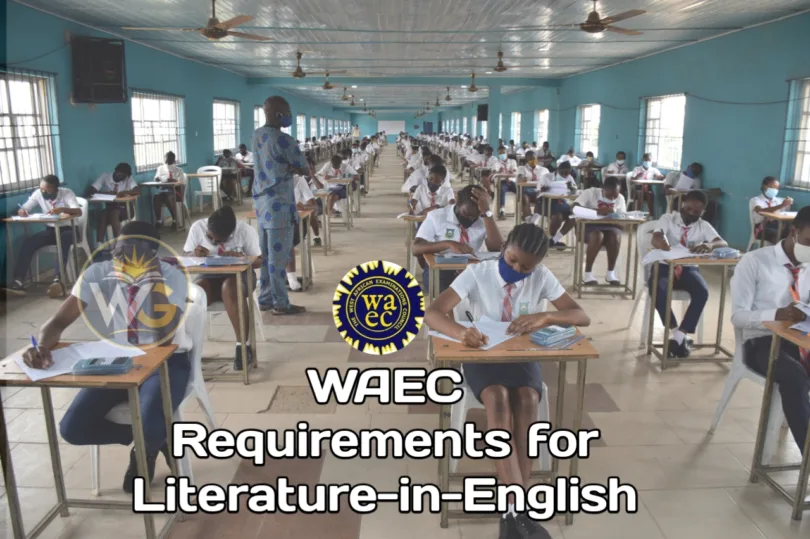

WAEC Requirements for Literature-in-English: Literature-in-English is one of the subjects students may choose when preparing for the West African Senior School Certificate Examination (WASSCE). It is particularly relevant to students interested in courses and careers connected with Arts, Humanities, Law, Mass Communication, Theatre Arts, English-related programmes, Education and other fields where strong language and literary skills are useful.
However, many students who want to register for Literature-in-English are unsure about the requirements. Some want to know whether Literature is compulsory, which other subjects they should register for, how many credits they need, whether Literature is required for university admission and whether they can study certain courses without it.
If you are searching for WAEC requirements for Literature-in-English, this guide explains what you need to know before choosing the subject. It covers the subject combination, minimum credit requirements, important topics, preparation tips, admission considerations and frequently asked questions.
Important: WAEC examination requirements and university admission requirements are not always the same. WAEC determines the requirements for sitting the examination, while universities and other tertiary institutions set their own admission requirements for specific courses. Always check the current requirements of the institution and course you intend to apply for.
What Is Literature-in-English?
Literature-in-English is a subject that involves the study and appreciation of literary works written in English.
Students learn how to understand, analyse and interpret different forms of literature, including prose, poetry and drama.
The subject is not simply about reading stories. Candidates are expected to understand literary techniques, themes, characters, settings, plots, language and the ways writers communicate ideas.
Literature can also improve students’ ability to analyse texts, express ideas and develop critical-thinking skills.
What Are the WAEC Requirements for Literature-in-English?
There is no separate requirement that says a student must already have a particular WAEC grade before being allowed to register for Literature-in-English.
Students who are eligible to sit the relevant WASSCE can take Literature-in-English as one of their registered subjects, subject to the examination’s applicable registration rules.
For students preparing for tertiary admission, however, the more important question is often whether Literature-in-English is required for their intended course.
The answer depends on the course and institution.
Some courses may require Literature-in-English as one of the relevant O’level subjects, while others may not.
Is Literature-in-English Compulsory in WAEC?
Literature-in-English is not compulsory for every WAEC candidate.
The subjects a candidate takes depend on their programme, school, intended course and the applicable examination requirements.
However, students should choose their subjects carefully if they plan to use their WAEC results for university, polytechnic or college of education admission.
A subject that is optional for the examination may become important for admission into a particular course.
Who Should Register for Literature-in-English?
Literature-in-English can be a good choice for students who enjoy reading, writing, analysing stories and discussing ideas.
It may be particularly useful for students interested in:
- Arts subjects.
- Humanities.
- Law.
- English-related programmes.
- Theatre and performing arts.
- Mass Communication.
- Education.
- Media-related fields.
- Some social science programmes.
Your intended course should guide your final subject selection.
WAEC Subject Combination for Literature-in-English
Literature-in-English is usually taken alongside other subjects appropriate to the student’s intended academic field.
A typical Arts-oriented combination may include subjects such as:
- English Language.
- Mathematics.
- Literature-in-English.
- Government.
- CRS or Islamic Religious Studies.
- Economics.
- Civic Education.
- Another relevant subject.
The exact combination depends on the student’s intended course and the requirements of the institution they plan to attend.
Is English Language Required With Literature-in-English?
English Language and Literature-in-English are different subjects.
English Language focuses more broadly on communication, comprehension, grammar, vocabulary, writing and language use.
Literature-in-English focuses on literary works and their analysis.
For tertiary admission, English Language is generally a core O’level requirement for many courses, while Literature-in-English may be required or recommended depending on the course.
Do not assume that passing Literature automatically replaces English Language.
Is Mathematics Required for Literature Students?
Mathematics is an important secondary-school subject, and many admission requirements include Mathematics among the required O’level subjects.
However, whether a particular grade in Mathematics is required for a specific course depends on the institution and programme.
Students should therefore not assume that choosing Literature means they can ignore Mathematics.
It is safer to prepare for both English Language and Mathematics while checking the requirements for the intended course.
How Many Credits Do You Need in WAEC?
For tertiary admission, many Nigerian institutions commonly require a minimum number of relevant O’level credits, often including English Language and, where applicable, Mathematics.
The exact number and subjects depend on the course and institution.
A student should not focus only on the total number of credits. The specific subjects in which the credits are obtained are often more important.
For example, having several credits does not necessarily satisfy a course requirement if one of the compulsory subjects is missing.
Is Literature-in-English Required for University Admission?
It depends on the course.
For some Arts and Humanities courses, Literature-in-English may be part of the required O’level subjects.
For other courses, it may not be compulsory.
This is why students should check the admission requirements for their specific course rather than relying on general statements about Literature.
WAEC Requirements for Studying English and Literary Studies
Students who intend to study English and Literary Studies should pay particular attention to Literature-in-English.
Many institutions require relevant O’level credits, and Literature-in-English may be among the subjects expected for the programme.
English Language is also particularly important.
Because requirements can vary between universities, candidates should check the current admission requirements of their chosen institution before finalising their subject combination.
WAEC Requirements for Studying Law
Law is a popular course among students who take Literature-in-English.
However, Literature-in-English alone does not qualify someone for admission into Law.
Law applicants generally need the required O’level credits in relevant subjects and must also satisfy the institution’s UTME and other admission requirements.
Students interested in Law should check the specific requirements of their chosen university.
Literature can be beneficial because it develops reading, interpretation and written communication skills, but it should not be treated as a substitute for other required subjects.
WAEC Requirements for Mass Communication
Mass Communication and related communication programmes may require candidates to have credits in English Language and other relevant subjects.
Whether Literature-in-English is compulsory depends on the institution and specific programme.
Students should therefore check the current requirements of their preferred university or polytechnic.
WAEC Requirements for Theatre Arts
Literature-in-English can be particularly relevant to students interested in Theatre Arts.
Theatre-related programmes often involve drama, performance, interpretation and literary analysis.
However, admission requirements vary.
Candidates should check the requirements for the specific institution and programme before registering their WAEC subjects.
WAEC Requirements for English Education
Students interested in English Education may also benefit from taking Literature-in-English.
Depending on the institution, Literature may form part of the relevant O’level requirements.
Other subjects, particularly English Language, remain important.
Always confirm the exact requirements before making your final subject choices.
Can You Study Literature-in-English Without Offering It in WAEC?
This depends on the course you want to study.
If Literature-in-English is not a compulsory O’level subject for your intended course, you may still be eligible to apply without it, provided you satisfy all other requirements.
However, if your intended course specifically requires Literature-in-English, not having the required credit may prevent you from meeting the admission requirements.
Can You Study Law Without Literature-in-English?
The answer depends on the admission requirements of the institution and programme.
Students should not assume that Literature is automatically compulsory or automatically unnecessary for every Law programme.
Check the current O’level requirements of your preferred institution before registering your subjects.
Even where it is not explicitly required, Literature-in-English can still be useful because Law involves extensive reading, interpretation and written communication.
Can You Combine Two WAEC Results for Literature Requirements?
Whether two O’level results can be combined depends on the institution and course.
Some institutions may accept two sittings for certain programmes, while others may impose restrictions.
Some competitive courses may have specific rules concerning one sitting or the number of results that can be combined.
Therefore, if you plan to combine two WAEC results, check the policy of your intended institution.
Can NECO and WAEC Results Be Combined?
Some institutions accept combinations of recognised O’level results, such as WAEC and NECO, provided the candidate meets their admission requirements.
However, acceptance is institution- and programme-specific.
Do not assume that every university will accept every combination.
Check the current admission guidelines before relying on a combination of results.
What Grade Should You Aim for in Literature-in-English?
If Literature-in-English is required for your intended course, aim for at least the minimum credit required by the institution.
However, obtaining a stronger grade is beneficial because it provides a better academic result and may help you meet requirements for competitive programmes.
Candidates should avoid preparing merely to obtain the minimum pass.
Aim for the best grade you can realistically achieve.
Understanding the WAEC Literature-in-English Syllabus
The Literature-in-English syllabus is designed to test students’ knowledge and understanding of literary works and literary techniques.
Candidates should study the prescribed texts applicable to their examination.
Depending on the examination structure and syllabus, Literature questions can involve prose, poetry and drama.
The exact prescribed texts can change, so candidates should use the current list applicable to their examination year.
How to Study WAEC Literature-in-English
Literature requires active reading.
Do not simply read each prescribed text once and assume you know it.
Read carefully and make notes as you go.
Record important information about:
- Characters.
- Themes.
- Plot development.
- Setting.
- Literary techniques.
- Major events.
- Relationships between characters.
- Important conflicts.
- Social issues.
- Symbolism.
These notes can become valuable revision material later.
How to Study Literature Prose
When studying a prose text, understand the entire story rather than memorising isolated summaries.
Pay attention to the beginning, development and ending of the story.
Understand why characters behave in particular ways and how their actions influence the plot.
Study the Characters
Create a character list.
For each major character, note:
- Personality.
- Background.
- Relationships.
- Major actions.
- Motivations.
- Conflicts.
- Development throughout the story.
This makes character questions easier to answer.
Study the Themes
Themes are central ideas explored in a literary work.
Do not simply memorise the names of themes.
Understand how each theme appears through characters, events, dialogue and conflicts.
For example, if a text explores betrayal, identify the events and relationships that demonstrate betrayal.
How to Study WAEC Poetry
Poetry requires careful attention to language.
When studying a poem, consider:
- Theme.
- Tone.
- Mood.
- Imagery.
- Figures of speech.
- Structure.
- Rhyme where applicable.
- Symbolism.
- Diction.
- Persona.
- Setting.
Understand Figures of Speech
You should recognise literary devices such as:
- Simile.
- Metaphor.
- Personification.
- Irony.
- Hyperbole.
- Alliteration.
- Onomatopoeia.
- Symbolism.
- Oxymoron.
- Repetition.
Do not only memorise their definitions.
Practise identifying them in actual poems and explaining their effects.
How to Study WAEC Drama
When studying drama, pay attention to characters, dialogue, conflicts, setting, themes and dramatic techniques.
Understand how events develop through the actions and conversations of the characters.
Study the Conflict
Conflict is often central to drama.
Identify the major conflicts and understand their causes and consequences.
Ask yourself:
- Who is involved?
- What caused the conflict?
- How does it develop?
- How is it resolved?
- What does the conflict reveal about the characters or society?
Practise Literature Past Questions
Past questions are very important because they help you understand how literary knowledge is tested.
After reading a prescribed text, attempt questions related to it.
Do not look at the answers immediately.
Try to explain your response from your own understanding before comparing it with your study materials.
How to Answer WAEC Literature Objective Questions
Read the question carefully.
Many objective questions test detailed knowledge of the prescribed texts.
Pay attention to:
- Character names.
- Events.
- Relationships.
- Themes.
- Locations.
- Literary techniques.
- Sequence of events.
Avoid selecting an answer simply because it sounds familiar.
How to Answer WAEC Literature Essay Questions
For essay questions, begin by understanding exactly what is being asked.
If the question asks you to discuss a character, focus on the character.
If it asks about a theme, provide evidence from the text showing how that theme develops.
Your answer should be organised into paragraphs.
Each paragraph should contribute directly to the question.
Use Evidence From the Text
When discussing a literary work, support your points with relevant references to events, characters or situations in the text.
You do not necessarily need to reproduce long passages.
Explain what happened and show how the event supports your argument.
Do Not Depend Only on Summary
A summary tells the examiner what happened.
Literature answers often require analysis of why something happened, what it means and how the writer presents it.
Therefore, do not write an answer that is simply a retelling of the story.
Connect events to themes, characters, techniques and the writer’s message.
Common WAEC Literature Mistakes to Avoid
Students can lose marks through simple mistakes.
Avoid:
- Reading only a summary instead of the prescribed text.
- Ignoring poetry or drama.
- Memorising character names without understanding their roles.
- Confusing characters.
- Writing only plot summaries.
- Ignoring literary devices.
- Giving irrelevant examples.
- Failing to answer the exact question.
- Writing extremely short explanations.
- Not practising past questions.
- Relying completely on predicted questions.
How to Pass WAEC Literature-in-English in Three Months
Three months can provide enough time for serious preparation if you have a clear plan.
Use the first month to read and understand the prescribed texts.
During the second month, focus on analysis, literary devices and past questions.
During the third month, practise essay answers, revise characters and themes, and complete timed questions.
Continue revisiting texts throughout the three months.
How to Pass WAEC Literature-in-English in One Month
If you have one month remaining, organise your reading carefully.
Divide the prescribed texts across the available weeks.
For each text, study:
- Plot.
- Characters.
- Themes.
- Setting.
- Literary devices.
- Major events.
- Important conflicts.
Then practise past questions.
How to Pass WAEC Literature-in-English in One Week
If your examination is only one week away, focus on structured revision.
Review the prescribed texts, important characters, major themes, literary devices and frequently tested areas.
Practise questions under timed conditions.
Avoid spending the entire week reading summaries without testing yourself.
Can You Pass WAEC Literature Without Reading the Full Text?
It is possible to answer some questions using summaries and study guides, but relying entirely on summaries is risky.
Summaries may leave out important details that can be tested in the examination.
Reading the prescribed texts gives you a better understanding of characters, events, language and themes.
Is Literature-in-English Difficult?
Literature-in-English can be challenging if you do not enjoy reading or if you try to memorise everything.
However, it becomes easier when you understand how to analyse texts.
The key is to read actively.
Ask questions while reading and make notes about important events, characters and themes.
Can Literature-in-English Help With Law?
Yes.
Although Literature-in-English does not by itself qualify someone for Law, studying Literature can develop useful skills.
These include:
- Reading comprehension.
- Critical analysis.
- Interpretation.
- Argument development.
- Written communication.
- Understanding different perspectives.
These skills can be useful in many academic disciplines, including Law.
Can Literature-in-English Be Used for University Admission?
Yes, where it forms part of the required O’level subjects for a particular course.
However, admission requirements vary by institution and course.
A Literature credit cannot automatically replace another compulsory subject.
Frequently Asked Questions
Is Literature-in-English compulsory in WAEC?
No. Literature-in-English is not compulsory for every WAEC candidate. Its importance depends on the student’s intended course and admission requirements.
What subjects should I combine with Literature-in-English?
A suitable combination depends on your intended course. English Language, Mathematics, Government, Economics, Religious Studies and other relevant subjects may form part of an Arts-oriented combination, but candidates should check their intended course requirements.
Is English Language compulsory with Literature-in-English?
English Language and Literature-in-English are separate subjects. English Language is commonly required for tertiary admission, while Literature may be required for particular courses.
Can I study Law without Literature-in-English?
It depends on the specific institution and course requirements. Check the current O’level requirements of the university you intend to attend.
Can I study English and Literary Studies without Literature-in-English?
This depends on the institution. Because Literature is closely related to the programme, candidates should carefully check the current requirements before choosing their WAEC subjects.
How many credits do I need for admission with Literature?
The required number of credits depends on the institution and course. More importantly, you must have credits in the specific subjects required for your intended programme.
Can I combine two WAEC results for admission?
Some institutions accept two O’level sittings, while others have restrictions for certain programmes. Check your institution’s current policy.
Can I combine WAEC and NECO results?
Some institutions permit combinations of recognised O’level results, but acceptance depends on the institution and programme.
What should I read for WAEC Literature-in-English?
Read the prescribed Literature-in-English texts applicable to your examination year. The list of prescribed texts can change, so use the current official or school-provided list.
Are Literature past questions important?
Yes. Past questions help you understand how the examination tests your knowledge of the prescribed texts and literary concepts.
How can I score high in WAEC Literature-in-English?
Read the prescribed texts carefully, understand characters and themes, learn literary devices, practise essay questions and support your answers with relevant evidence from the texts.
Do I need to memorise the entire Literature textbook?
No. Understanding is more important than memorising an entire textbook. However, you should know important details from the prescribed texts.
Is Literature-in-English difficult to pass?
It does not have to be. With regular reading, proper analysis and past-question practice, you can improve your performance significantly.
Can I pass Literature-in-English by reading summaries?
Summaries can help with revision, but they should not replace the prescribed texts. Important examination details may be missing from summaries.
How can I remember characters in Literature?
Create a character chart showing each character’s role, personality, relationships, major actions and importance to the story.
How can I remember themes?
Connect each theme to specific characters, events and situations in the text. This is more effective than memorising a list of themes without examples.
How can I improve my Literature essay answers?
Practise answering questions and focus on analysis rather than simply retelling the plot. Make sure each paragraph directly supports your argument.
Conclusion
The requirements for Literature-in-English depend largely on the examination rules and the course you intend to study after WAEC. Literature is not compulsory for every candidate, but it can be an important O’level subject for several Arts and Humanities-related programmes.
To prepare effectively, study the applicable syllabus, read your prescribed texts carefully, understand characters and themes, learn literary devices and practise past questions. Most importantly, confirm the current admission requirements of your chosen institution before finalising your WAEC subject combination.